16 Chapter 16: Intrapersonal and Interpersonal Business Communication
“Identity is the essential core of who we are as individuals, the conscious experience of the self inside.”
—Kauffman
Opening Case The Stone Between Them
Imelda Vostritsa-Quinlan parked her Subaru in the gravel lot of the Windlass Creek Heritage Grist Mill at 8:47 a.m. Her interview for the executive director position was at nine. She sat behind the wheel for a moment, watching the morning mist lift off the millpond, and tried to remember what her coach had told her six weeks ago: You do not know how you come across. You think you do, but you don’t. Trust the prep.
She had prepped. Three weeks of research. She knew the mill had been built in 1847, that Sherman’s troops had spared it because the miller’s wife had fed a Union captain’s horse, that the waterwheel had been rebuilt in 1978 and again in 2014, and that the current executive director, Temperance Olusegun-Harlowe, was stepping down in June after eleven years. She knew the Spring Sorghum & Stone-Ground Festival brought in roughly a third of the mill’s annual revenue, and she knew this year’s festival was fourteen days away. She knew the board chair’s name (Solene Pritchard-Kawamoto, retired pediatric dentist, six years on the board), and she knew the mill’s 990 from last fiscal year by memory.
What she did not know was that she was about to walk straight into a conflict that had been simmering since Tuesday.
Imelda crossed the footbridge over the millrace and pulled open the heavy pine door. The scent of cornmeal and machine oil hit her in a wave. Inside, the main floor was quiet. A tour group wouldn’t arrive until ten. Temperance was in her office, but she wasn’t alone. Imelda heard voices before she saw anyone. A woman’s voice, calm but tight. A man’s voice, pitched higher than the woman’s, louder, and not calm at all.
“—told Barnaby on Monday, I told him, the number-three burr needs dressing before we run the sorghum flour, and he says fine, fine, and then this morning I walk in and the dressing kit is gone. Gone, Temperance. Off-site. He sent it to the sharpener in Athens without telling me.”
“Corny, please sit.”
“I’ve been running those burrs for twenty years. Twenty. And the new operations manager—who’s been here six weeks—decides on his own that—”
“Corny.”
A pause. Imelda froze in the hallway. She was fifteen feet from Temperance’s office door and had not yet announced herself. She took one careful step back, but the floorboards at Windlass Creek were honest 1847 heart pine, and they creaked.
The door opened.
Temperance Olusegun-Harlowe was a tall woman, sixty-three, gray hair pulled back into a braid that fell halfway down her spine. She wore a denim work shirt and a face that had just been arranged, in the last second, into something that looked like welcome. Behind her, a man in his late fifties with flour on his forearms and red in his cheeks was settling heavily into a chair, arms crossed. That had to be Cornelius Fernsby-Odinga. “Corny” on the mill’s website. The bio had called him the lead miller and the heart of Windlass Creek.
“Ms. Vostritsa-Quinlan,” Temperance said. “You’re early. Come in.”
“I can wait in the lobby.”
“No, please. Solene is running behind. Corny and I were just finishing.” Temperance’s voice carried a quality Imelda recognized from her own years in nonprofit administration: the voice of someone asking a colleague, without asking, to please not continue in front of a stranger.
Corny did not look up.
Imelda stepped into the office. She shook Temperance’s hand, shook Corny’s hand (cool, calloused, the grip of a man who did not particularly want to shake her hand this morning), and took the visitor’s chair by the window. Through the glass, she could see the waterwheel turning slowly, the same eighteen-foot cypress wheel that had appeared on every page of the mill’s website.
“I’ll get us coffee,” Temperance said, and left.
Corny and Imelda were alone.
She felt her internal monologue kick in immediately: Don’t mention what you heard. Don’t pretend you didn’t hear it, either. Don’t offer an opinion. Don’t ask a question that sounds like an interview question. You are not the director yet. You are a guest. The monologue ran faster than her mouth, which was a useful thing, because her mouth wanted to say something and she wasn’t sure what.
Corny broke the silence first. “You’re interviewing for Temperance’s job.”
“I am.”
“Where are you coming from?”
“I’m the associate director at a historic farmstead in Floyd County. We run a ten-acre heritage orchard and a cider mill. Smaller than Windlass Creek, but similar operationally.”
“Cider mill.” He nodded once. His arms stayed crossed. “You ever dressed a burr stone?”
“No.”
“You ever run one?”
“No.”
“You know what happens if you run sorghum through a burr that’s out of true?”
She paused. She could invent an answer. She could say something general about quality. Instead she said, “I don’t. Walk me through it.”
And for the first time since she’d walked in, Cornelius Fernsby-Odinga looked at her. Not at the space where a candidate would be sitting, but at her. He uncrossed his arms.
“Sorghum grain is soft. Softer than corn, softer than wheat. If your burr is even a sixteenth out of true, you’ll cook the flour in the grind. The starch will scorch, and the batch will taste like pennies. Twenty-two hundred pounds of sorghum from Mr. Akinyemi’s farm. That’s what’s in the silo. That’s what’s going through my mill in ten days for the festival.”
“And the dressing kit is in Athens.”
“The dressing kit is in Athens.”
“Because Barnaby sent it to a sharpener.”
“Because Barnaby made a decision that wasn’t his to make.”
The office door opened. Temperance came back with three mugs. She handed one to Imelda, one to Corny. Behind her, a younger man in rimless glasses was standing in the hall, holding a clipboard and looking uncomfortable. That would be Barnaby Dunmire-Chen, operations manager, six weeks on the job, formerly a program officer at a community foundation in Atlanta. Imelda had found his LinkedIn.
Temperance saw Imelda see him. She said, “Barnaby, give us ten minutes. I’ll come find you.”
Barnaby nodded and disappeared.
Temperance settled behind her desk. “Ms. Vostritsa-Quinlan. I apologize for the timing. Solene is on her way. Before we start the formal interview, I’m going to ask you something I wasn’t planning to ask. Consider it off the record if you like, but I’d appreciate a thoughtful answer.”
“All right.”
Temperance set her coffee down. “You walked into the middle of a disagreement. You heard part of it, you met one of the people involved, and you have not yet met the other. In about forty minutes, Solene is going to ask you how you approach conflict in the workplace. You’ll answer that question then. Right now, though, I want to know what you’re actually thinking. Not the interview answer. The real one. What do you make of what you’ve just walked into, and what would you do next?”
Imelda looked at Corny, who had not taken a sip of his coffee. She looked at the closed door where Barnaby had disappeared. She looked at Temperance, who was watching her with the patient attention of someone who had conducted a great many of these interviews in her life and had learned to tell the prepared answers from the unprepared ones, and who preferred, this morning, the unprepared ones.
Imelda opened her mouth.
Reflection Write
Getting Started
Introductory Exercises
- Define yourself in five words or less.
- Describe yourself in no less than twenty words and no more than fifty.
- List what is important to you in priority order. List what you spend your time on in rank order. Compare the results.
What are you doing? This simple question sits at the heart of an application that lets users stay hyperconnected. Before we look at social media and what it means for business communication, let’s first consider the central question X asks its users to address in 280 characters or less.
What are you doing right now? Are you reading, learning, or have you already tuned out this introduction and jumped over to X to see what your friends are up to? We often define ourselves through our actions, but that definition doesn’t hold up well. When you were a newborn baby, your actions represented a tiny fraction of your potential. Now that you’re older, you’re more than an eating machine that requires constant care and feeding—but what are you? A common answer might be “human,” but even that’s surprisingly hard to pin down. If we say humans are the tool makers and then notice that several nonhuman species, from primates to otters, make and use tools, where does that leave us? You could say a human has two arms, two legs, or two eyes, but not everyone does, so the definition fails again. You might point out that you can communicate, but we don’t all speak the same language, and communication happens across species. You may be tempted to answer the question “what are you?” with something like “I think, therefore I am”—but what is thinking, and are humans the only species that can think? Once again, defining yourself through your ability to think might not work. Finally, you might raise your ability to reason and act, recall the past, stay conscious of the present, and imagine the future—or your capacity to ponder the abstract, the ironic, even the absurd. Now we might be getting somewhere.
What does the word “party” mean to you? Most cultures have rituals where people gather in a common space for conversation and sharing. These gatherings often include food, music, and dancing. In our modern society, we increasingly lack time to connect with others. It may be too expensive or time-consuming to travel across the country for Thanksgiving, but we can meet on Zoom and talk at relatively little or no cost. Some of your instructors may have traveled to a designated location for a professional conference each year, seeing colleagues and networking, but in recent years, time, cost, and competition for attention have shifted priorities for many. We may have two (or three or four) jobs that consume much of our time, but you’ll notice that in the breaks and pauses of life, people reach for their cell phones to connect. We post, text, tweet, email, and interact. As humans, we have an innate need to communicate with each other, even when that connection can (and does) sometimes produce conflict.
When we ask, “What are you doing?” the answer almost always involves communication—communication with self, with others, in verbal (oral and written) and nonverbal ways. How do we come to this, and how does it shape our experience in the business environment? How do we enter a new community through a rite of initiation, often called a job interview, only to find ourselves lost as everyone speaks a new language—the language of the workplace? How do we negotiate relationships and demands for space and time across meetings, collaborative efforts, and solo projects? This chapter addresses several of these questions as we try to answer “What are you doing?” with: communicating.
16.1 Intrapersonal Communication
Learning Objectives
- Discuss intrapersonal communication.
When you answer the question “What are you doing?” what do you write? Eating at your favorite restaurant? Working on a slow evening? Reading your favorite book on a Kindle? Do you prefer the feel of paper to keyboard? Reading by candlelight? In each case, you’re communicating what you’re doing, but you may not be communicating why or what it means to you. That communication may be internal, but is it only internal?
Intrapersonal communication is communication with yourself, and it includes self-talk, acts of imagination and visualization, and even recall and memory.[1] You read on your cell phone screen that your friends are going to have dinner at your favorite restaurant. What comes to mind? Sights, sounds, and scents? Something special that happened the last time you were there? Do you contemplate joining them? Do you start working out a plan for getting from your present location to the restaurant? Do you send your friends a text asking if they want company? Until the moment you hit the “send” button, you’re communicating with yourself.
Case Connection
Communications expert Leonard Shedletsky examines intrapersonal communication through the eight basic components of the communication process (source, receiver, message, channel, feedback, environment, context, and interference) as transactional, but with all the interaction occurring within the individual.[2] Perhaps, as you consider whether to leave your present location and join your friends at the restaurant, you’re aware of all the work sitting in front of you. You may hear the voice of your boss, or perhaps of one of your parents, warning you about personal responsibility and duty. On the other hand, you may imagine the friends at the restaurant saying something like “you deserve some time off!”
While you argue with yourself, Judy Pearson and Paul Nelson would add that intrapersonal communication isn’t just your internal monologue—it also includes your efforts to plan how to get to the restaurant.[3] From planning to problem solving, internal conflict resolution, and evaluations and judgments of self and others, we communicate with ourselves through intrapersonal communication.
Pro Tip: Name the Voices
All this interaction takes place in the mind without externalization, and all of it relies on previous interaction with the external world. If you had been born in a different country, to different parents, what language would you speak? What language would you think in? What would you value, what would be important to you, and what would not? Even as you argue to yourself whether joining your friends at the restaurant outweighs your need to complete your work, you use language and symbols that were communicated to you. Your language and culture have given you the means to rationalize, act, and answer the question “What are you doing?” but you’re still bound by the expectations of yourself and the others who make up your community.
Key Takeaways
Exercises
- Describe what you are doing, pretending you are another person observing yourself. Write your observations down or record them with a voice or video recorder. Discuss the exercise with your classmates.
- Think of a time when you used self-talk—for example, giving yourself “I can do this!” messages when striving to meet a challenge, or “what’s the use?” messages when discouraged. Did you purposely choose to use self-talk, or did it just happen? Discuss your thoughts with classmates.
- Take a few minutes and visualize what you’d like your life to look like a year from now, or five years from now. Do you think this visualization exercise will influence your actions and decisions in the future? Compare your thoughts with those of your classmates.
16.2 Self-Concept and Dimensions of Self
Learning Objectives
- Define and discuss self-concept.
Let’s return again to the question “What are you doing?” as one way to approach self-concept. If we define ourselves through our actions, what might those actions be, and are we no longer ourselves when we stop engaging in those activities? Psychologist Steven Pinker defines the conscious present as about three seconds for most people. Everything else is past or future. [4]
Who are you at this moment in time, and will the self you become an hour from now be different from the self reading this sentence right now?
Just as the communication process is dynamic, not static (constantly changing, not staying the same), you too are a dynamic system. Physiologically, your body is in a constant state of change as you inhale and exhale air, digest food, and cleanse waste from each cell. Psychologically, you’re constantly changing as well. Some aspects of your personality and character will stay constant, while others will shift and adapt to your environment and context. That complex combination contributes to the self you call yourself. We might define self as one’s sense of individuality, personal characteristics, motivations, and actions—but any definition we create will fail to fully capture who you are and who you’ll become.[5]
Self-Concept
Our self-concept is “what we perceive ourselves to be,” and it involves aspects of image and esteem. How we see ourselves and how we feel about ourselves shape how we communicate with others.[6] What you’re thinking now and how you communicate impact and influence how others treat you. Charles Cooley calls this the looking-glass self. We look at how others treat us, what they say and how they say it, for clues about how they view us—and we use those clues to gain insight into our own identity.[7] Leon Festinger added that we engage in social comparisons, evaluating ourselves against peers of similar status, characteristics, or qualities.[8]
Case Connection
The ability to think about how, what, when, and why we think is central to intrapersonal communication. Animals may use language and tools, but can they reflect on their own thinking? Self-reflection is a trait that allows us to adapt and change to our context or environment, to accept or reject messages, to examine our concept of ourselves and choose to improve.
Internal monologue refers to the self-talk of intrapersonal communication. It can be a running monologue that’s rational and reasonable, or disorganized and illogical. It can interfere with listening to others, impede your ability to focus, and become a barrier to effective communication. Alfred Korzybski suggested that the first step in becoming conscious of how we think and communicate with ourselves is to achieve an inner quietness—in effect, “turning off” our internal monologue.[9] Learning to be quiet inside can be a challenge. We can choose to listen to others when they communicate through the written or spoken word, and refraining from preparing our responses before they finish is essential. We can take mental note of when we jump to conclusions from only partially attending to the speaker’s or writer’s message. We can choose to listen to others instead of ourselves.
Common Mistake: Rehearsing the Rebuttal
One principle of communication is that interaction is always dynamic and changing. That interaction can be internal, as in intrapersonal communication, but can also be external. We may communicate with one another and engage in interpersonal communication. If we engage two or more people (up to about eight), group communication is the result. More than eight normally leads to subdivisions within the group and a reversion to smaller groups of three to four members due to the ever-increasing complexity of the communication process.[10] With each new person comes a multiplier effect on the number of possible interactions, and for many, that means the need to set limits.
Dimensions of Self
Who are you? You’re more than your actions and more than your communication; the result may be greater than the sum of the parts. But how do you know yourself? In the first of the Note 16.1 “Introductory Exercises” for this chapter, you were asked to define yourself in five words or less. Was it a challenge? Can five words capture what you consider yourself to be? Was your twenty to fifty word description easier? Or was it equally hard? Did your description focus on your characteristics, beliefs, actions, or other factors? If you compared your results with classmates or coworkers, what did you observe? For many, these exercises prove challenging as we try to reconcile our self-concept with what we want others to perceive about us, as we try to see ourselves through our interactions with others, and as we come to terms with the idea that we may not be aware of—or know—everything there is to know about ourselves.
Joseph Luft and Harry IngramLuft, J., & Ingham, H. (1955). The Johari Window: A graphic model for interpersonal relations. Los Angeles: University of California Western Training Lab.,Luft, J. (1970). Group processes: An introduction to group dynamics (2nd ed.). Palo Alto, CA: National Press Group. gave considerable thought and attention to these dimensions of self, which are represented in Figure 16.1 “Luft and Ingram’s Dimensions of Self”. In the first quadrant, information is known to you and others, such as your height or weight. The second quadrant represents things others observe about us that we’re unaware of, like how many times we say “umm” in five minutes. The third quadrant involves information that you know but don’t reveal to others. It may involve actively hiding or withholding information, or it may involve social tact, such as thanking your Aunt Martha for the large purple hat she gave you that you know you’ll never wear. The fourth quadrant involves information unknown to you and your conversational partners. For example, a childhood experience that’s been long forgotten or repressed may still motivate you. Or consider: how will you handle an emergency after you’ve received first aid training? No one knows because it hasn’t happened yet.
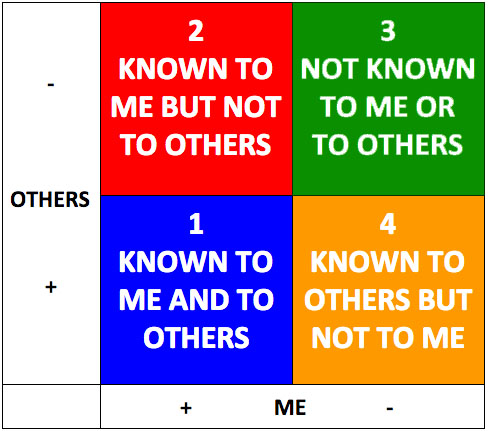
These dimensions of self remind us that we’re not fixed—that the freedom to change, combined with the ability to reflect, anticipate, plan, and predict, allows us to improve, learn, and adapt to our surroundings. By recognizing that we aren’t fixed in our concept of “self,” we come to terms with the responsibility and freedom inherent in our potential humanity.
Try It: Your Own Four Quadrants
In business communication, the self plays a central role. How do you describe yourself? Do your career path, job responsibilities, goals, and aspirations align with what you recognize as your talents? How you represent “self”—through your résumé, in your writing, in your articulation and presentation—all of this plays an important role as you negotiate the relationships and climate present in any organization.
Key Takeaways
Exercises
- Examine your academic or professional résumé—or, if you don’t have one, create one now. According to the dimensions of self described in this section, which dimensions contribute to your résumé? Discuss your results with your classmates.
- How would you describe yourself in terms of the dimensions of self shown in Figure 16.1 “Luft and Ingram’s Dimensions of Self”? Discuss your thoughts with a classmate.
- Can you think of a job or career that would be a good way for you to express yourself? Are you pursuing that job or career? Why or why not? Discuss your answer with a classmate.
16.3 Interpersonal Needs
Learning Objectives
- Understand the role of interpersonal needs in the communication process.
You may have had no problem answering “What are you doing?” and pulled a couple of lines from yesterday’s X message or reviewed your iPhone calendar. But if you had to compose an entirely original answer, would it be a challenge? Perhaps at first this seems simple. You have to work, and your job requires your participation in a meeting. Or you care about someone and met them for lunch.
Both scenarios make sense on the surface, but we need to consider the why more deeply. Why that meeting, and why that partner? Why not another job, or a lunch date with someone else? If we consider the question long enough, we’ll come around to the conclusion that we communicate with others to meet basic needs, and our meetings, interactions, and relationships help us meet those needs. We may also recognize that not all our needs are met by any one person, job, experience, or context; instead, we diversify our communication interactions to meet our needs. At first, you may be skeptical that we communicate to meet our basic needs, but let’s look at two theories on the subject and see how well they predict, describe, and anticipate our tendency to interact.
Abraham Maslow’s hierarchy of needs, represented in Figure 16.2 “Maslow’s Hierarchy of Needs,” may be familiar to you.[11] Perhaps you saw it in negotiation or international business classes and recognized its universal applicability. We need the resources in level one (air, food, and water) to survive. If we’ve met those basic needs, we move to level two: safety. We want to make sure we’re safe and that our access to air, food, and water is secure. A job may represent this level of safety at its most basic. Regardless of how much satisfaction you may get from a job well done, a paycheck ultimately represents meeting basic needs for many. Still, for others, sacrifice is part of the job. Can you think of any professions that require individuals to make decisions where the safety of others comes first? “First responders” and others who work in public safety often place themselves at risk for the benefit of those they serve.
If we feel safe and secure, we’re more likely to seek the companionship of others. Humans tend to form groups naturally, and if basic needs are met, love and belonging occur in level three. Have you ever been new at work and didn’t understand the first thing about what was really going on? It’s not that you weren’t well-trained or didn’t receive a solid education—rather, the business or organization is made up of groups and communities that communicate and interact in distinct and divergent ways. You may have known how to do something, but not how it was done at your new place of work. Colleagues may have viewed you as a stranger or “newbie” and may have even declined to help you. Conflict may have been part of your experience, but if you were lucky, a mentor or coworker took the first step and helped you find your way.
Case Connection
As you came to know what was what and who was who, you learned how to navigate the landscape and avoid landmines. Your self-esteem (level four) improved as you perceived a sense of belonging, but you still may have lacked the courage to speak up.
Over time, you may have learned your job tasks and the strategies for succeeding in your organization. Perhaps you even came to be known as a reliable coworker, one who went the extra mile, one who helped the “newbies” around the office. If one of them came to you with a problem, you’d know how to handle it. You’re now looked up to by others and by yourself within the role, with your ability to make a difference. Maslow calls this “self-actualization” (level five), and discusses how people come to perceive a sense of control or empowerment over their context and environment. Where they once felt at the mercy of others, particularly when they were new, they can now influence and direct aspects of the work environment that were once unavailable.
Beyond self-actualization, Maslow recognizes our innate need to know (level six) that drives us to grow and learn, explore our environment, or engage in new experiences. We come to appreciate a sense of self that extends beyond our immediate experiences, beyond the function, and into the community and the representational. We can take in beauty for its own sake and value aesthetics (level seven) that we previously ignored or had little time to consider.
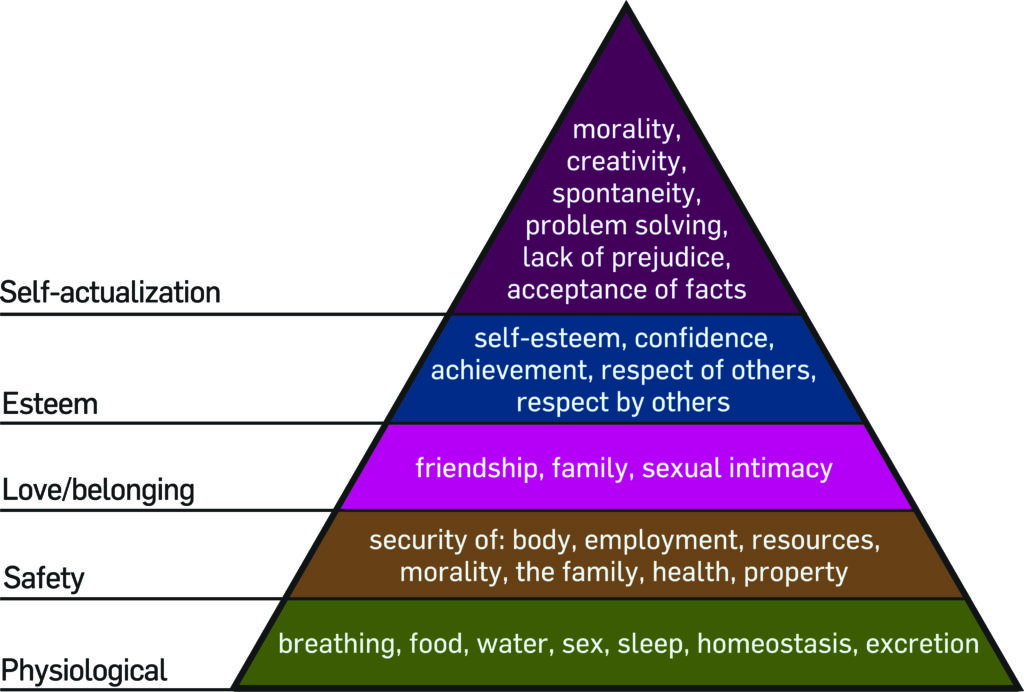
This theory of interpersonal needs is individualistic, and many cultures aren’t centered on the individual, but it gives us a useful starting point for discussing interpersonal needs. What do we need? Why do we communicate? The answers to both questions are often related.
William Schutz offers an alternate version of interpersonal needs. Like Maslow, he considers the universal aspects of our needs, but he outlines how they operate within a range or continuum for each person.[12] According to Schutz, the need for affection, or appreciation, is basic to all humans. We all need to be recognized and feel like we belong, but we may have different expectations for meeting that need. When part of the merger process is announced and the news of layoffs comes, those coworkers who’ve never been particularly outgoing and have largely kept to themselves may become even more withdrawn. Schutz describes underpersonals as people who seek limited interaction. On the opposite end of the spectrum, you may know people at work who often seek attention and affirmation. Schutz describes overpersonals as people who have a strong need to be liked and constantly seek attention from others. The person who strikes a healthy balance is called a personal individual.
Humans also have a need for control, or the ability to influence people and events. But that need may vary by context, environment, and sense of security. You may have already researched similar mergers, as well as the forecasts for the new organization, and realized that your position and your department are central to the current business model. You may have also taken steps to prioritize your budget, assess your transferable skills, and look for opportunities beyond your current context. Schutz would describe your efforts to control your situation as autocratic, or self-directed. At the same time, there may be several employees who haven’t taken similar steps and look to you and others for leadership, essentially abdicating their responsibility. Abdicrats shift the burden of responsibility from themselves to others, looking to others for a sense of control. Democrats share the need between the individual and the group, and may try to hold a departmental meeting to gather information and share.
Finally, Schutz echoes Maslow in asserting that belonging is a basic interpersonal need, but notes that it exists within a range or continuum, where some need more and others less. Undersocials may be less likely to seek interaction, may prefer smaller groups, and generally won’t be found on center stage. Oversocials, however, crave the spotlight of attention and are highly motivated to seek belonging. A social person strikes a healthy balance between being withdrawn and being the constant center of attention.
Pro Tip: Read the Room for Needs, Not Personalities
Schutz describes these three interpersonal needs of affection, control, and belonging as interdependent and variable. In one context, a person may have a high need for control, while in another, they may not perceive the same level of motivation or compulsion to meet that need. Both Maslow and Schutz offer us two related versions of interpersonal needs that begin to address the central question: why communicate?
We communicate with each other to meet our needs, regardless of how we define those needs. From the time you’re a newborn infant crying for food or a toddler learning to say “please” when requesting a cup of milk, to the time you’re an adult learning the rituals of the job interview and the conference room, you learn to communicate in order to gain a sense of self within the group or community, meeting your basic needs as you grow and learn.
Key Takeaways
Exercises
- Review the types of individuals from Schutz’s theory described in this section. Which types do you think fit you? Which types fit some of your coworkers or classmates? Why? Share your opinions with your classmates and compare your self-assessment with the types they believe describe you.
- Think of two or more different situations and how you might express your personal needs differently from one situation to another. Have you observed similar variations in other people from one situation to another? Discuss your thoughts with a classmate.
16.4 Social Penetration Theory
Learning Objectives
- Discuss social penetration theory, self-disclosure, and its principles.
- Describe interpersonal relations.
How do you get to know other people? If the answer springs immediately to mind, we’re getting somewhere: communication. Communication allows us to share experiences, come to know ourselves and others, and form relationships, but it requires time and effort. You don’t get to know someone in a day, a month, or even a year. At the same time you’re coming to know them, they’re changing, adapting, and growing—and so are you. Irwin Altman and Dalmas Taylor describe this progression from superficial to intimate levels of communication in social penetration theory, often called the Onion Theory because the model looks like an onion and involves layers that are peeled away.[13] According to social penetration theory, we fear what we don’t know. That includes people. Strangers go from being unknown to known through a series of steps that we can observe in conversational interactions.
If we didn’t have the weather to talk about, what would we say? People across cultures use a variety of signals to indicate neutral or submissive stances in relation to each other. A wave, a nod, or a comment about a beautiful day can indicate an open, approachable stance rather than a guarded, defensive posture. At the outermost layer of the onion in this model, there’s only what we can observe. We can observe characteristics about each other and make judgments, but they’re educated guesses at best. Our nonverbal displays of affiliation—like a team jacket, a uniform, or a badge—may communicate something about us. But we only peel away a layer when we engage in conversation, oral or written.
As we move from public to private information, we make the transition from small talk to substantial, and eventually intimate, conversations. Communication requires trust, and that often takes time. Beginnings are fragile times, and when expectations, roles, and ways of communicating aren’t clear, misunderstandings can occur. Some relationships may never move past observations about the weather, while others may explore controversial topics like politics or religion. A married couple that has spent countless years together may be able to finish each other’s sentences. As memory fades, the retelling of stories may bond and reinforce the relationship. Increasingly, intimate knowledge and levels of trust are achieved over time, involving frequency of interaction as well as length and quality. Positive interactions may lead to more positive interactions, while negative ones may lead to fewer overall interactions.
Case Connection
This may seem like common sense at first, but let’s look at an example. You’re new to a position, and your supervisor has been in his or her role for years. Some people at your same level within the organization enjoy a level of knowledge and ease of interaction with your supervisor that you lack. They may have had more time and interactions with the supervisor, but you can still use this theory to gain trust and build a healthy relationship. Recognize that you’re unknown to your supervisor and vice versa. Start with superficial conversations that are neutral and nonthreatening, but that demonstrate a willingness to engage in communication. Silence early in a relationship can be a sign of respect, but it can also send the message that you’re fearful, shy, or lack confidence. It can be interpreted as an unwillingness to communicate and may actually discourage interaction. If the supervisor picks up the conversation, keep your responses short and light. If not, keep an upbeat attitude and mention the weather.
Over time, the conversations may gradually grow to cross topics beyond the scope of the office, and a relationship may form that involves trust. To a degree, you and your coworkers learn to predict one another’s responses and relax in the knowledge of mutual respect. If, however, you skip from superficial to intimate topics too quickly, you risk violating normative expectations. Trust takes time, and with it comes empathy and understanding. But if you share your struggles with your supervisor on day one, it may erode your credibility. According to social penetration theory, people go from superficial to intimate conversations as trust develops through repeated, positive interactions. Self-disclosure is “information, thoughts, or feelings we tell others about ourselves that they would not otherwise know.”[14] Taking it step by step, and not rushing to self-disclose or asking personal questions too soon, can help develop positive business relationships.
Principles of Self-Disclosure
Write down five terms that describe your self, and five terms that describe your professional self. Once you’ve completed your two lists, compare them. They may have points that overlap, or they may have words that describe you in your distinct roles that are quite different. This difference can be easy to address, but at times it can be a challenge to maintain. How much of “you” do you share in the workplace? Our personal and professional lives don’t exist independently—in many ways, they’re interdependent.
How do people know more about us? We communicate information about ourselves, whether or not we’re aware of it. You cannot not communicate.[15] From your internal monologue and intrapersonal communication to verbal and nonverbal communication, communication is constantly occurring. What do you communicate about yourself through the clothes (or brands) you wear, the tattoos you display, or the piercings you remove before entering the workplace? Self-disclosure is a process by which you intentionally communicate information to others, but it can involve unintentional, revealing slips. Steven Beebe, Susan Beebe, and Mark Redmond offer us five principles of self-disclosure that remind us communication is an integral part of any business or organizational setting. Let’s discuss them one by one.[16]
Self-Disclosure Usually Moves in Small Steps
Would you come to work on your first day wearing a large purple hat? Especially if you knew that office attire was primarily brown and gray suits? Most people would say, “Of course not!” because there’s a normative expectation for dress, sometimes called a dress code. After you’ve worked within the organization, earned trust and established credibility, and earned your place in the community, the purple hat might be positively received with a sense of humor. But if you haven’t yet earned your place, your fashion statement may be poorly received. In the same way, personal information is normally reserved for those you trust, and trust is earned over time. Take small steps as you come to know your colleagues, making sure who you are doesn’t speak louder than what you say.
Self-Disclosure Moves from Impersonal to Intimate Information
So you decided against wearing the purple hat to work on your first day, but after a successful first week, you went out with friends from your college days. You shut down the bar late in the evening and paid for it on Sunday. At work on Monday, is it wise to share the finer tips of the drinking games you played on Saturday night? Again, most people would say, “Of course not!” It has nothing to do with work and only makes you look immature. Some people have serious substance abuse issues, and your stories could sound insensitive, producing a negative impact. How would you know, since you don’t really know your coworkers yet? In the same way, it’s not wise to post photos from the weekend’s escapades on your Instagram, Facebook, or similar social networking site. Employers are increasingly aware of their employees’ web pages, and the picture of you looking foolish may come to mind when your supervisor is considering you for a promotion. You represent yourself, but you also represent your company and its reputation. If you don’t represent it well, you risk not representing it at all.
Self-Disclosure Is Reciprocal
Monday morning brings the opportunity to tell all sorts of stories about the weekend. Since you’ve wisely decided to leave any references to the bar in the past, you may instead ask questions. You may ask your coworkers what they did, what it was like, who they met, and where they went, but eventually all conversations form a circle that comes back to you. The dance between source and receiver isn’t linear; it’s transactional. After a couple of stories, sooner or later, you’ll hear the question, “What did you do this weekend?” Now it’s your turn. This aspect of conversation is universal. We expect that when we reveal something about ourselves, others will reciprocate. The dyadic effect is the formal term for this process and is often thought to meet the need to reduce uncertainty about conversational partners. If you stay quiet or decline to answer after everyone else has taken a turn, what will happen? They may be put off at first, they may invent stories and let their imaginations run wild, or they may reject you. It may be subtle at first, but reciprocity is expected.
You have the choice of what to reveal and when. You may choose to describe your weekend by telling your friends about conversations while omitting any reference to the bar. You may choose to focus on your Sunday afternoon gardening activities. You may say you read a good book and mention the title. Regardless of what option you choose, you have the freedom and responsibility within the dyadic effect to reciprocate—but you have a degree of control. You can learn to anticipate when your turn will come and prepare what you’ll say before the moment arrives.
Self-Disclosure Involves Risk
If you decided to go with the “good book” option, or perhaps mention that you watched a movie, you’ve run the risk that whatever you’re reading or watching may be criticized. If the book you’re enjoying is controversial, you might anticipate a bit of a debate, but if you mentioned a romance novel or one with a science fiction theme, you may have thought it wouldn’t generate criticism. Sometimes, the most innocent reference or comment can produce conflict when the conversational partners have little prior history. At the same time, nothing ventured, nothing gained. How are you going to discover that your coworker appreciates the same author or genre if you don’t share that information? Self-disclosure involves risk, but can produce positive results.
Self-Disclosure Involves Trust
Before you mention the title of the book or movie you saw this weekend, you may consider your audience and what you know about them. If you’ve only known them for a week, your awareness of their habits, quirks, likes, and dislikes may be limited. At the same time, if you feel safe and relatively secure, you may test the waters with a reference to the genre but not the author. You may also decide that it’s just a book, and they can take it or leave it.
“Trust is the ability to place confidence in or rely on the character or truth of someone.”[17] Trust is a process, not a badge to be earned. It takes time to develop and can be lost in a moment. Even if you disagree with your coworker, understand that self-revelation communicates a measure of trust and confidence. Respect that confidence, and respect yourself.
Ethical Consideration: Required Disclosure
Also, consider the nature of the information. Some information communicated in confidence must see the light of day. Sexual harassment, fraud, theft, and abuse are all issues in the workplace. If you become aware of these behaviors, you’ll have a responsibility to report them according to your organization’s procedures. A professional understands that trust is built over time and recognizes the value of this intangible commodity to success.
Interpersonal Relationships
Interpersonal communication is communication between two people, but the definition fails to capture the essence of a relationship. This broad definition helps when we compare it to intrapersonal communication, or communication with ourselves, as opposed to mass communication, or communication with a large audience—but it requires clarification. The developmental view of interpersonal communication places emphasis on the relationship rather than the size of the audience, and distinguishes impersonal from personal interactions.
For example, one day your coworker and best friend, Iris, whom you’ve come to know on a personal as well as a professional level, gets promoted to manager. She didn’t tell you ahead of time because it wasn’t certain, and she didn’t know how to bring up the possible change of roles. Your relationship with Iris will change as your roles transform. Her perspective will change, and so will yours. You may stay friends, or she may not have as much time as she once did. Over time, you and Iris gradually grow apart, spending less time together. You eventually lose touch. What’s the status of your relationship?
If you’ve ever had even a minor interpersonal transaction, such as buying a cup of coffee from a clerk, you know that some people can be personable—but does that mean you’ve developed a relationship within the transaction? For many people, the transaction is an impersonal experience, however pleasant. What’s the difference between the brief interaction of a transaction and the interactions you periodically have with your colleague, Iris, who’s now your manager?
The developmental view emphasizes prior history, but also focuses on the level of familiarity and trust. Over time and with increased frequency, we form bonds or relationships with people, and if time and frequency are diminished, we lose that familiarity. The relationship with the clerk may be impersonal, but so can the relationship with the manager over time and as familiarity fades. From a developmental view, interpersonal communication can exist across this range of experience and interaction.
Review the lists you made for the third part of the Note 16.1 “Introductory Exercises” for this chapter. If you evaluate your list of what’s important to you, will you find objects or relationships? You may value your home or vehicle, but for most people, relationships with friends and family are at the top of the list. Interpersonal relationships take time and effort to form, and they can be challenging. All relationships are dynamic, meaning they transform and adapt to changes within the context and environment. They require effort and sacrifice, and at times give rise to the question, Why bother? A short answer may be that we, as humans, are compelled to form bonds. But it still doesn’t answer the question, why?
Uncertainty theory states that we choose to know more about others with whom we interact in order to reduce or resolve the anxiety associated with the unknown.[18][19][20] The more we know about others and become accustomed to how they communicate, the better we can predict how they’ll interact with us in future contexts. If you learn that Monday mornings are never a good time for your supervisor, you quickly learn to schedule meetings later in the week. Predicted outcome value theory asserts that not only do we want to reduce uncertainty, we also want to maximize our possible benefit from the association.[21][22] [23] This theory would predict that you’d choose Tuesday or later for a meeting in order to maximize the potential for positive interaction and any possible rewards that may result. One theory involves the avoidance of fear, while the other focuses on the pursuit of reward. Together, they provide a reference point as we continue our discussion on interpersonal relationships.
Whether we focus on collaboration or competition, we can see that interpersonal communication is necessary in the business environment. We want to know our place and role within the organization, accurately predict those within our proximity, and create a sense of safety and belonging. For many, family is the first experience in interpersonal relationships. But as we develop professionally, our relationships at work may take on many of the attributes we associate with family communication. We look to each other with similar sibling rivalries, competition for attention and resources, and support. The workplace and our peers can become as close, or closer, than our birth families, with similar challenges and rewards.
Key Takeaways
- Interpersonal relationships are an essential part of the work environment.
- We come to know one another gradually.
- Self-disclosure involves risk and reward, and is a normal part of communication.
Exercises
- Write down five terms that describe yourself, and five terms that describe your professional self. Compare your results with a classmate.
- Think of someone you trust and who trusts you. How did you come to have a mutually trusting relationship? Did it take effort on both people’s parts? Discuss your thoughts with a classmate.
- How important do you think self-disclosure is in business settings? Give some examples. Discuss your thoughts with a classmate.
16.5 Rituals of Conversation and Interviews
Learning Objectives
- Understand the five steps in any conversation.
- Discuss employment interviewing.
You’ve no doubt participated in countless conversations throughout your life, and the process of how to conduct a conversation may seem so obvious that it needs no examination. Yet all cultures have rituals of various kinds, and conversation is one of these universal rituals. A skilled business communicator knows when to speak, when to remain silent, and when to stop talking before the audience stops listening. And understanding conversation provides a solid foundation for our subsequent discussion on employment interviewing. Employment interviews follow similar ritual patterns and have their own set of expectations. Expectations may differ based on field, level, knowledge, and experience, but they generally follow the five steps of a basic conversation.
Conversation as a Ritual
Why discuss the ritual of conversation? Because it’s one of the main ways we interact in the business environment, and it’s ripe for misunderstandings. Our everyday familiarity with conversations often makes us blind to the subtle changes that take place during a conversation. Examining it will allow you to consider its components, predict the next turn, anticipate an opening or closing, and make you a better conversationalist. Steven Beebe, Susan Beebe, and Mark Redmond offer us five stages of conversation that are adapted here for our discussion.[24]
Initiation
The first stage of conversation is called initiation, and it requires you to be open to interacting. How you communicate openness is up to you; it may involve nonverbal signals like eye contact or body positions, such as smiling or simply facing the other person and making eye contact. A casual reference to the weather, a light conversation about the weekend, or an in-depth discussion about how the financial markets are performing this morning requires someone to start the process: someone has to initiate the exchange. For some, this may produce a degree of anxiety. If status and hierarchical relationships are present, it may be a question of who speaks when, according to cultural norms. The famous anthropologist Bronislaw Malinowski called small talk “phatic communion,” reinforcing the idea that there’s a degree of ritual across cultures in initiating, engaging, and concluding conversations.[25]
Preview
The preview is an indication, verbal or nonverbal, of what the conversation is about, both in terms of content and relationship. A word or two in the subject line of an email may signal the topic, and the relationship between individuals, such as an employee-supervisor relationship, may be understood. A general reference to a topic may approach it indirectly, allowing the recipient either to pick up on the topic and engage or to redirect the conversation away from a topic they’re not ready to discuss. People are naturally curious and also seek certainty. A preview can reduce uncertainty and signal intent.
Talking Point(s)
Joseph DeVito characterizes this step as getting down to business, reinforcing the goal orientation of the conversation.DeVito, J. (2003). Messages: Building interpersonal skills. Boston, MA: Allyn & Bacon. In business communication, we often have a specific goal or series of points to address, but we can’t lose sight of the relationship messages within the content discussion. You may signal to your conversation partner that there are three points to address, much like outlining an agenda at a meeting. This may sound formal at first, but if you listen to casual conversations, you’ll often find there’s an inherent list or central point where the conversational partners arrive. By clearly articulating, either in written or oral form, the main points, you provide an outline or structure to the conversation.
Feedback
Similar to a preview step, this stage allows the conversational partners to clarify, restate, or discuss the points of the conversation to arrive at a mutual understanding. In some cultures, the points and their feedback may be recycled several times, which may sound repetitious to Western ears. In Western cultures, we often get to the point rather quickly, and once we’ve arrived at an understanding, we move quickly to the conclusion. Communication across cultures frequently requires additional cycles of statement and restatement to ensure transmission of information as well as reinforcement of the relationship. Time may be money in some cultures, but time is also a representation of respect. Feedback is an opportunity to make sure the interaction was successful the first time. Failing to attend to this stage can lead to additional interactions, reducing efficiency over time.
Closing
Acceptance of feedback on both sides of the conversation often signals the transition to the conclusion. Closings are similar to the initiation step and often involve ritual norms.[26][27] Verbal clues are sometimes present, but you may also notice the half-step back as conversational partners create additional space in preparation to disengage.
There are times when a conversational partner introduces new information in the conclusion, which can start the process all over again. You may also note that if words like “in conclusion” or “oh, one more thing” are used, a set of expectations is now in force. A conclusion has been announced, and the listener expects it. If the speaker continues to recycle at this point, the listener’s listening skills often aren’t as keen as they were during the main engagement, and it may even produce frustration. People mentally shift to the next order of business, and this transition must be negotiated successfully.
By mentioning a time, date, or place for future communication, you can clearly signal that the conversation, although currently concluded, will continue later. In this way, you can often disengage successfully while demonstrating respect.
Employment Interviewing
We all join communities, teams, and groups across our lifetimes.[28] We go from an unknown outsider to a new member and eventually a full member. Businesses and organizations are communities consisting of teams and groups. If we decide to switch teams or communities, or if that decision is made for us with a reduction-in-force layoff, for example, we’ll be back on the job market. To make the transition from outsider to insider, you’ll have to pass a series of tests, both informal and formal. One of the most common tests is the employment interview. An employment interview is an exchange between a candidate and a prospective employer (or their representative). It’s a formal process with several consistent elements that you can use to guide your preparation.
Employment interviews come in all shapes and sizes and may not be limited to only one exchange. A potential employee may very well be screened by a computer (as the résumé is scanned) and interviewed online or via telephone before ever meeting a representative or panel of representatives. The screening process may include an initial phone call, a pre-recorded video interview, an interview with an AI, formal personality or skills tests, and consultations with previous employers. Depending on the type of job you’re seeking, you can anticipate answering questions, often more than once, to a series of people as you progress through a formal interview process. Just as you can prepare for a speech with anticipation, you can apply the same research and public speaking skills to the employment interview.
The invitation to interview means you’ve been identified as a candidate who meets the minimum qualifications and shows promise. Your cover letter, résumé, or related application materials may illustrate the connection between your preparation and the job duties, but now comes the moment when you’ll need to articulate those points out loud.
If we assume that you’d like to be successful in your employment interviewing, it makes sense to use the communication skills you’ve gained, combined with your knowledge of interpersonal communication, to maximize your performance. There’s no one right or wrong way to prepare and present at your interview—just as each audience is unique—but we can prepare and anticipate several common elements.
Preparation
The right frame of mind is an essential element for success in communication, oral or written. For many, if not most, the employment interview is surrounded with mystery and a degree of fear and trepidation. Just as giving a speech may produce a certain measure of anxiety, you can expect that a job interview will make you nervous. Anticipate this normal response, and use your nervous energy to your benefit. To put your energies to best use, the first step is preparation.
Would you prepare yourself before writing for publication or speaking in public? Of course. The same preparation applies to the employment interview. Briefly, the employment interview is a conversational exchange (even if it’s in writing at first) where the participants try to learn more about each other. Both conversational partners will have goals in terms of content, and explicitly or implicitly, across the conversational exchange, there will be relational messages. Attending to both points will strengthen your performance.
On the content side, if you’ve been invited for an interview, you can rest assured that you’ve met the basic qualifications the employer is looking for. Hopefully, this initiation signal means that the company or organization you’ve thoroughly researched is one you’d consider as a potential employer. Perhaps you’ve involved colleagues and current employees of the organization in your research process and learned about several of the organization’s attractive qualities as well as some of the challenges experienced by the people working there.
Businesses hire people to solve problems, so you’ll want to focus on how your talents, expertise, and experience can contribute to the organization’s need to solve those problems. The more detailed your analysis of their current challenges, the better. You need to be prepared for standard questions about your education and background, but also see the opening in the conversation to discuss the job duties, the challenges inherent in the job, and the ways you believe you can meet these challenges. Take the opportunity to demonstrate that you’ve “done your homework” in researching the company. Table 16.1 “Interview Preparation Checklist” presents a checklist of what you should try to know before you consider yourself prepared for an interview.
| What to Know | Examples |
|---|---|
| Type of Interview | Will it be a behavioral interview, where the employer watches what you do in a given situation? Will you be asked technical questions or given a work sample? Or will you be interviewed over lunch or coffee, where your table manners and social skills will be assessed? |
| Type of Dress | Office attire varies by industry, so stop by the workplace and observe what workers are wearing if you can. If this isn’t possible, call and ask the human resources office what to wear—they’ll appreciate your wish to be prepared. |
| Company or Organization | Do a thorough exploration of the company’s website. If it doesn’t have one, look for business listings in the community online and in the phone directory. Contact the local chamber of commerce. |
| Job | Carefully read the ad you answered that got you the interview, and memorize what it says about the job and the qualifications the employer is seeking. Use the internet to find sample job descriptions for your target job title. Make a written list of the job tasks and annotate the list with your skills, knowledge, and other attributes that will enable you to perform the job tasks with excellence. |
| Employer’s Needs | Check for any items in the news in the past couple of years involving the company name. If it’s a small company, the local town newspaper will be your best source. Also, look for any advertisements the company has placed, as these can give a good indication of the company’s goals. |
Case Connection
Performance
You may want to know how to prepare for an employment interview, and we’ll assume that you’ve researched the company, market, and even individuals in your effort to learn more about the opportunity. From this solid base of preparation, you need to begin preparing your responses. Would you like some of the test questions before the test? Luckily for you, employment interviews involve a degree of uniformity across their many representations. Here are eleven common questions you’re likely to be asked in an employment interview:[29]
- Tell me about yourself.
- Have you ever done this type of work before?
- Why should we hire you?
- What are your greatest strengths? Weaknesses?
- Give me an example of a time when you worked under pressure.
- Tell me about a time you encountered (X) type of problem at work. How did you solve the problem?
- Why did you leave your last job?
- How has your education and/or experience prepared you for this job?
- Why do you want to work here?
- What are your long-range goals? Where do you see yourself three years from now?
- Do you have any questions?
When you’re asked a question in the interview, look for its purpose as well as its literal meaning. “Tell me about yourself” may sound like an invitation to share your text message win in last year’s competition, but it’s not. The employer is looking for someone who can address their needs. Telling the interviewer about yourself is an opportunity to make a positive professional impression. Consider what experience you can highlight that aligns well with the job duties, and match your response to their needs.
In the same way, responses about your strengths aren’t an opening to brag, and your weaknesses aren’t an invitation to confess. If your weakness is a tendency toward perfectionism and the job you’re applying for involves detail orientation, you can highlight how your weaknesses may serve you well in the position.
Consider using the “because” response whenever you can. A “because” response involves restating the question, followed by a statement of how and where you gained education or experience in that area. For example, if you’re asked about handling demanding customers, you could answer that you have significant experience in that area because you’ve served as a customer service representative with X company for X years. You may be able to articulate how you turned an encounter with a frustrated customer into a long-term relationship that benefited both the customer and the organization. Your specific example and use of a “because” response can increase the likelihood that the interviewer or audience will recall the specific information you provide.
Common Mistake: The Rehearsed Story That Doesn’t Fit
You may be invited to a telephone interview, which remains a common practice for initial screenings. Since this format carries your voice and words but no visual cues, you need to be especially mindful of your delivery. Speak directly into the phone and remember to look up and smile; your voice will sound clearer and more pleasant. Don’t take the call in a noisy environment or on an unreliable signal, as interviewers will be unfavorably impressed if you keep breaking up. Use the phone to your advantage by having your prepared responses and notes on your computer screen or note cards before the call. Keep your responses concise, aiming for about a minute per answer, and be aware of the time to respect the interviewer’s schedule.
However, video interviews on platforms like Zoom, Microsoft Teams, or Google Meet have become the new standard. This format requires all the same skills as a phone interview but adds a new set of visual considerations. Make sure your background is clean and professional, and that you have good lighting. Your eye contact is also crucial; look at the camera lens, not the screen, to give the impression of looking directly at your interviewer. Just like a phone call, test your technology—your microphone, camera, and internet connection—well before the interview. Prepare your notes and keep them within easy view, and be mindful of your time. Your professionalism will shine through your preparedness and attention to both verbal and visual details.
You can also anticipate that the last few minutes will be set aside for you to ask your questions. This is your opportunity to learn more about the problems or challenges that the position will be addressing, allowing you a final chance to reinforce a positive message with the audience. Keep your questions simple, your attitude positive, and communicate your interest.
At the same time you’re being interviewed, know that you, too, are interviewing the prospective employer. If you’ve done your homework, you may already know what the organization is all about, but you may still be unsure whether it’s the right fit for you. Listen and learn from what’s said as well as what’s not said, and you’ll add to your knowledge base for wise decision-making in the future.
Above all, be honest, positive, and brief. You may have heard that the world is small, and it’s true. As you develop professionally, you’ll come to see how fields, organizations, and companies are interconnected in ways you can’t anticipate. Your name and reputation are yours to protect and promote.
Postperformance
You completed your research of the organization, interviewed a couple of employees, learned more about the position, were on time for the interview (virtual or in person), wore neat and professional clothes, and demonstrated professionalism in your brief, informative responses. Congratulations are in order, but so is more work on your part.
Remember that feedback is part of the communication process: follow up promptly with a thank-you note or email, expressing your appreciation for the interviewer’s time and interest. You may also indicate that you’ll call or email next week to see if they have any further questions for you. (Naturally, if you say you’ll do this, make sure you follow through!) If you’ve decided the position isn’t right for you, the employer will appreciate your notifying them without delay. Do this tactfully, keeping in mind that communication occurs between individuals and organizations in ways you can’t predict.
After you’ve communicated with your interviewer or committee, move on. Candidates sometimes become quite fixated on one position or job and fail to keep their options open. The best person doesn’t always get the job, and the prepared business communicator knows that networking and research are a never-ending, ongoing process. Look over the horizon at the next challenge and begin your research process again. It may be hard work, but getting a job is your job. Budget time and plan on the effort it will take to make the next contact, get the next interview, and continue to explore alternate paths to your goal.
You may receive a letter, note, or voice mail explaining that another candidate’s combination of experience and education better matches the job description. If this happens, it’s natural to feel disappointed. It’s also natural to want to know why you weren’t chosen, but be aware that, for legal reasons, most rejection notifications don’t go into detail about why one candidate was hired and another wasn’t. Contacting the company with a request for an explanation can be counterproductive, as it may be interpreted as a “sore loser” response. If there’s any possibility they’ll keep your name on file for future opportunities, you want to preserve your positive relationship.
Although you feel disappointed, don’t focus on the loss or all the hard work you’ve put in. Instead, focus your energies where they’ll serve you best. Review the process and learn from the experience, knowing that each audience is unique and even the most prepared candidate may not have been the right “fit.” Stay positive and connect with people who support you. Prepare, practice, and perform. Know that you, as a person, are far more than just a list of job duties. Focus on your skill sets: if they need improvement, consider additional education that will enhance your knowledge and skills. Seek out local resources and keep networking. Have your professional interview attire clean and ready, and focus on what you can control—your preparation and performance.
Key Takeaways
Exercises
- How does the employment interview serve both the interviewer and the interviewee? Explain and present your thoughts to the class.
- Identify a company that you might be interested in working for. Use the resources described in this section to research information about the company, the kinds of jobs it hires people to do, and the needs and goals of the organization. Share your findings with your classmates.
- Find a job announcement for a position that might interest you after you graduate or reach your professional goal. Write a brief statement of what experience and education you currently have that applies to the position, and note what you currently lack.
- What are the everyday tasks and duties of a job you find interesting? Create a survey, identify people who hold a similar position, and interview them (via email or in person). Compare your results with your classmates.
- What has been your employment interview experience to date? Write a brief statement and provide examples.
- What employment-related resources are available on your campus or in your community? Investigate and share your findings.
- Prepare for a job that you’d like to do by finding a job announcement, preparing sample responses, and enlisting a friend or colleague to play the role of a mock interviewer. Limit your interview to fifteen minutes and record it (audio or audio/visual) and post it in class. If your instructor indicates this exercise will be an in-class exercise or assessment, dress the part and be completely prepared. Use this exercise to prepare for the moment when you’ll be required to perform and when you want the job.
16.6 Conflict in the Work Environment
Learning Objectives
- Understand evaluations and criticism in the workplace, and discuss several strategies for resolving workplace conflict.
The word “conflict” produces a sense of anxiety for many people, but it’s part of the human experience. Just because conflict is universal doesn’t mean we can’t improve how we handle disagreements, misunderstandings, and struggles to understand or make ourselves understood. Joyce Hocker and William Wilmot offer several principles on conflict that have been adapted here for our discussion:[30]
- Conflict is universal.
- Conflict is associated with incompatible goals.
- Conflict is associated with scarce resources.
- Conflict is associated with interference.
- Conflict is not a sign of a poor relationship.
- Conflict cannot be avoided.
- Conflict cannot always be resolved.
- Conflict is not always bad.
Conflict is the physical or psychological struggle associated with the perception of opposing or incompatible goals, desires, demands, wants, or needs.[31] When incompatible goals, scarce resources, or interference are present, conflict is a typical result, but it doesn’t mean the relationship is poor or failing. All relationships progress through times of conflict and collaboration. How we navigate and negotiate these challenges influences, reinforces, or destroys the relationship. Conflict is universal, but how and when it occurs is open to influence and interpretation. Rather than viewing conflict from a negative frame of reference, view it as an opportunity for clarification, growth, and even reinforcement of the relationship.
Case Connection
Conflict Management Strategies
As professional communicators, we can acknowledge and anticipate that conflict will be present in every context or environment where communication occurs. To that end, we can predict, anticipate, and formulate strategies to address conflict successfully. How you choose to approach conflict influences its resolution. Joseph DeVito offers several conflict management strategies that we’ve adapted and expanded for our use.[32]
Avoidance
You may choose to change the subject, leave the room, or not even enter the room in the first place, but the conflict will remain and resurface when you least expect it. Your reluctance to address the conflict directly is a normal response, and one that many cultures prize. In cultures where independence is highly valued, confrontation is more common. In cultures where the community is emphasized over the individual, indirect strategies may be more common. Avoidance allows more time to resolve the problem, but can also increase costs associated with the problem in the first place. Your organization or business will have policies and protocols to follow regarding conflict and redress. Still, it’s always wise to consider the position of your conversational partner or opponent and to give them, as well as yourself, time to explore alternatives.
Defensiveness versus Supportiveness
Jack Gibb discussed defensive and supportive communication interactions as part of his analysis of conflict management.[33] Defensive communication is characterized by control, evaluation, and judgments, while supportive communication focuses on the points and not personalities. When we feel judged or criticized, our ability to listen can be diminished, and we may only hear the negative message. By choosing to focus on the message instead of the messenger, we keep the discussion supportive and professional.
Face-Detracting and Face-Saving
Communication isn’t competition. Communication is the sharing of understanding and meaning, but does everyone always share equally? People struggle for control, limit access to resources and information as part of territorial displays, and otherwise use the process of communication to engage in competition. People also use communication for collaboration. Both competition and cooperation can be observed in communication interactions, but two concepts are central to both: face-detracting and face-saving strategies.
Face-detracting strategies involve messages or statements that undermine the respect, integrity, or credibility of a person. Face-saving strategies protect credibility and separate the message from the messenger. For example, you might say that “sales were down this quarter” without specifically noting who was responsible. Sales were down. If, however, you ask, “How does the sales manager explain the decline in sales?” you’ve specifically connected an individual with the negative news. While we may want to connect tasks and job responsibilities to individuals and departments, in terms of language, each strategy has distinct results.
Face-detracting strategies often produce a defensive communication climate, inhibit listening, and allow little room for collaboration. To save face is to raise the issue while preserving a supportive climate, allowing room in the conversation for constructive discussions and problem-solving. By using a face-saving strategy to shift emphasis from the individual to the issue, we avoid power struggles and personalities, providing each other space to save face.[34]
Pro Tip: Name the Problem, Not the Person
In collectivist cultures, where the community’s well-being is promoted or valued above that of the individual, face-saving strategies are a common communicative strategy. In Japan, for example, to confront someone directly is perceived as humiliation, a great insult. In the United States, greater emphasis is placed on individual performance, and responsibility may be more directly assessed. If our goal is to solve a problem and preserve the relationship, then a face-saving strategy should be one option a skilled business communicator considers when addressing negative news or information.
Empathy
Communication involves not only the words we write or speak, but also how and when we write or say them. The way we communicate also carries meaning, and empathy for the individual involves attending to this aspect of interaction. Empathetic listening involves listening to both the literal and implied meanings within a message. For example, the implied meaning might involve understanding what has led this person to feel this way. By paying attention to feelings and emotions associated with content and information, we can build relationships and address conflict more constructively. In management, negotiating conflict is a common task, and empathy is one strategy to consider when trying to resolve issues.
Gunnysacking
George Bach and Peter Wyden discuss gunnysacking (or backpacking) as the imaginary bag we all carry, into which we place unresolved conflicts or grievances over time.[35] If your organization has gone through a merger and your business has transformed, there may have been conflicts that occurred during the transition. Holding onto the way things used to be can be like a stone in your gunnysack, influencing how you interpret your current context.
People may be aware of similar issues but might not know your history and can’t see your backpack or its contents. For example, if your previous manager handled problems in one way and your new manager handles them differently, this may cause you stress and frustration. Your new manager can’t see how the relationship existed in the past, but will still observe the tension. Bottling up your frustrations only hurts you and can cause your current relationships to suffer. By addressing or unpacking the stones you carry, you can better assess the current situation with the current patterns and variables.
We learn from experience, but we can distinguish between old wounds and current challenges and try to focus our energies where they’ll make the most positive impact.
Managing Your Emotions
Have you ever seen red or perceived a situation through rage, anger, or frustration? Then you know that you can’t see or think clearly when experiencing strong emotions. There will be times in the work environment when emotions run high. Your awareness of them can help you clear your mind and choose to wait until the moment has passed to tackle the challenge.
“Never speak or make a decision in anger” is one common saying that holds true, but not all emotions involve fear, anger, or frustration. A job loss can be a sort of professional death for many, and the sense of loss can be profound. Losing a colleague to a layoff while retaining your position can bring pain as well as relief, and a sense of survivor’s guilt. Emotions can be contagious in the workplace, and fear of the unknown can influence people to act in irrational ways. The wise business communicator can recognize when emotions are running high—in themselves or others—and choose to wait to communicate, problem-solve, or negotiate until the moment has passed.
Evaluations and Criticism in the Workplace
Mary Ellen Guffey wisely notes that Xenophon, a Greek philosopher, once said, “The sweetest of all sounds is praise.”[36] We’ve seen that appreciation, respect, inclusion, and belonging are all basic human needs across all contexts, and are particularly relevant in the workplace. Efficiency and morale are positively related, and recognition of good work is essential. But there may come a time when evaluations involve criticism. Knowing how to approach this criticism can give you peace of mind to listen clearly, separating subjective, personal attacks from objective, constructive requests for improvement. Guffey offers seven strategies for giving and receiving evaluations and criticism in the workplace that we’ve adapted here.
Listen without Interrupting
If you’re on the receiving end of an evaluation, start by listening without interruption. Interruptions can be internal and external, and warrant further discussion. If your supervisor starts to discuss a point and you immediately start debating the point in your mind, you’re paying attention to yourself and what you think they said or are going to say—not what’s actually communicated. This gives rise to misunderstandings and will cause you to lose valuable information you need to understand and address the issue at hand.
External interruptions may involve your attempt to get a word in edgewise and may change the course of the conversation. Let them speak while you listen, and if you need to take notes to focus your thoughts, take clear notes of what’s said, also noting points to revisit later. External interruptions can also take the form of a telephone ringing, a “text message has arrived” chime, or a coworker dropping by in the middle of the conversation.
As an effective business communicator, you know to consider the context and climate of the communication interaction when approaching the delicate subject of evaluations or criticism. Choose a time and place free from interruption. Choose one outside the common space where there may be many observers. Turn off your cell phone. Choose face-to-face communication instead of an impersonal email. By providing a space free of interruption, you’re displaying respect for the individual and the information.
Determine the Speaker’s Intent
We’ve discussed previews as a normal part of conversation, and in this context, they play an important role. People want to know what’s coming and generally dislike surprises, particularly when the context of an evaluation is present. If you’re on the receiving end, you may need to ask a clarifying question if it doesn’t count as an interruption. You may also need to take notes and write down questions that come to mind to address when it’s your turn to speak. As a manager, be clear and positive in your opening and lead with praise. You can find one point, even if it’s only that the employee consistently shows up to work on time, to highlight before transitioning to a performance issue.
Indicate You Are Listening
In mainstream U.S. culture, eye contact is a signal that you’re listening and paying attention to the person speaking. Take notes, nod your head, or lean forward to show you’re listening. Whether you’re the employee receiving the criticism or the supervisor delivering it, displaying listening behavior engenders a favorable climate that helps mitigate the challenge of negative news or constructive criticism.
Paraphrase
Restate the main points to paraphrase what’s been discussed. This verbal display allows for clarification and acknowledges receipt of the message.
If you’re the employee, summarize the main points and consider the steps you’ll take to correct the situation. If none come to mind or you’re nervous and having a hard time thinking clearly, state the main point out loud and ask if you can provide solution steps and strategies at a later date. You can request a follow-up meeting if appropriate, or indicate you’ll respond in writing via email to provide the additional information.
If you’re the employer, restate the main points to ensure that the message was received, since not everyone hears everything that’s said or discussed the first time it’s presented. Stress can impair listening, and paraphrasing the main points can help address this common response.
If You Agree
If an apology is well deserved, offer it. Communicate clearly what will change or indicate when you’ll respond with specific strategies to address the concern. As a manager, you’ll want to formulate a plan that addresses the issue and outlines responsibilities as well as time frames for corrective action. As an employee, you’ll want to take specific steps that you can both agree on to solve the problem. Clear communication and acceptance of responsibility demonstrate maturity and respect.
If You Disagree
If you disagree, focus on the points or issue, not on personalities. Don’t bring up past issues, and keep the conversation focused on the task at hand. You may want to suggest, now that you better understand their position, a follow-up meeting to give you time to reflect on the issues. You may want to consider involving a third party, investigating the problem further, or taking time to cool off.
Don’t respond in anger or frustration; instead, always display professionalism. If the criticism is unwarranted, consider that the information they have may be flawed or biased, and consider ways to learn more about the case to share with them, searching for a mutually beneficial solution.
If other strategies to resolve the conflict fail, consider contacting your human resources department to learn more about due process procedures at your workplace. Display respect and never say anything that would reflect poorly on yourself or your organization. Words spoken in anger can have a lasting impact and are impossible to retrieve or take back.
Learn from Experience
Every communication interaction provides an opportunity for learning if you choose to see it. Sometimes the lessons are situational and may not apply in future contexts. Other times, the lessons learned may well serve you across your professional career. Taking notes for yourself to clarify your thoughts, much like a journal, helps document and clarify the situation.
Recognize that some aspects of communication are intentional and may communicate meaning, even if it’s hard to understand. Also know that some aspects of communication are unintentional and may not convey intended meaning. People make mistakes. They say things they shouldn’t have said. Emotions are revealed that aren’t always rational, nor are they always associated with the current context. A challenging morning at home can spill over into the work day, and someone’s bad mood may have nothing to do with you.
Try to distinguish between what you can control and what you can’t, and always choose professionalism.
Key Takeaways
Exercises
- Write a description of a situation you recall where you came into conflict with someone else. It may be something that happened years ago or a current issue that just arose. Using the principles and strategies in this section, describe how the conflict was resolved, or could have been resolved. Discuss your ideas with your classmates.
- Of the strategies for managing conflict described in this section, which do you think are the most effective? Why? Discuss your opinions with a classmate.
- Can you think of a time when a conflict led to a new opportunity, better understanding, or other positive result? If not, think of a past conflict and imagine a positive outcome. Write a two- to three-paragraph description of what happened, or what you imagine could happen. Share your results with a classmate.
Closing Case Analysis: The Stone Between Them, Resolved
Imelda opened her mouth and said, “I’d tell you what I saw, and I’d tell you what I don’t yet know.”
Temperance waited.
“What I saw was a lead miller who is angry because a decision was made about his equipment, and a new operations manager who made that decision without a conversation. What I don’t know is whether Barnaby understood the decision wasn’t his alone to make, or whether he thought he was doing his job. I don’t know what Corny has been carrying into this week that started before this week. And I don’t know what your standing practice is when the two of them disagree—whether there’s a protocol, or whether they’ve been handling it between themselves until now.”
“Go on.”
“What I’d do next has two parts. The first part is this afternoon. I wouldn’t try to mediate. I don’t work here yet. The people who need to be in the room for the first conversation are Corny, Barnaby, and you. The second part is the festival. That’s a hard deadline, fourteen days out, and twenty-two hundred pounds of sorghum doesn’t care whose feelings are hurt. So whatever the long-term resolution looks like, the short-term resolution is: the dressing kit has to be back on this property, on that burr, before Mr. Akinyemi’s sorghum gets run. Someone needs to get in a truck and drive to Athens today. If that happens, the festival doesn’t get damaged. If it doesn’t happen, the festival gets damaged regardless of who turns out to have been right about anything else.”
Corny, for the first time that morning, looked over at Temperance. Then he looked down at his coffee, which he finally picked up and drank.
Temperance said, “And the second question. How would you approach the long-term conflict?”
Imelda took a breath. This was the interview question. She let it be the interview question.
“I’d want to understand what Barnaby thought his authority was when he made the call. If he thought operational decisions about equipment maintenance were his to make, that’s a job-description conversation, and that’s a conversation you and he should have had on week one, not week six. If he knew it wasn’t his decision and made it anyway because he thought Corny was slow-walking him, that’s a different conversation, and Barnaby is the one who needs to hear it. Either way, I wouldn’t frame the conversation as Corny versus Barnaby. I’d frame it around the question, ‘Who decides, and who gets consulted, on each category of decision this mill makes?’ That question isn’t about the dressing kit. The dressing kit is just how you found out you hadn’t answered the question yet.”
She paused. She had said more than she’d intended. Then she said, “And I’d apologize to Corny for speaking about him in the third person while he’s sitting in the room.”
She turned to Corny. “I’m sorry. I should have been speaking to you, not about you.”
Corny nodded once.
The office door opened and Solene Pritchard-Kawamoto walked in, out of breath, coat half off, apologizing. Temperance stood up. She looked at Corny, then at Imelda. “Corny, thank you. I’ll find you in the mill in twenty minutes. Solene, this is Imelda Vostritsa-Quinlan. She and I were just finishing an off-the-record conversation, and I think we’re now ready for the interview.”
Let’s apply the concepts from Chapter 16 to what just happened.
Intrapersonal communication (§16.1). From the moment Imelda heard the raised voices through the door to the moment she answered Temperance, her internal monologue was working overtime. She caught herself wanting to say the interview-coach answer and made a deliberate choice not to. The quality of her answer wasn’t a function of her prep checklist. It was a function of whether she could hear her own self-talk clearly enough to choose which voice to speak from. Korzybski’s “inner quietness” is not silence. It’s the ability to listen to yourself long enough to decide which version of yourself gets the microphone.
Self-concept and the looking-glass self (§16.2). Corny’s willingness to uncross his arms was not a response to Imelda’s résumé. It was a response to the mirror she held up. When she said “No. Walk me through it,” she signaled that her self-concept did not require her to pretend to know things she didn’t know. Cooley’s theory predicts exactly what happened next: Corny used the reflection he got from Imelda—a person who didn’t need to look smart at his expense—to reshape the mirror he was holding up to her, too. Both people’s self-concept shifted a little in the exchange.
Interpersonal needs (§16.3). Apply Schutz’s framework to all three people in the office. Corny’s control need was triggered when his equipment was rerouted without his consent; his affection need was triggered by the feeling that his twenty years didn’t register. Barnaby, whom we barely saw, is six weeks in and almost certainly trying to establish his belonging need by being visibly competent. Imelda, in the interview, is trying to meet her own belonging need (does this job fit?) while also carefully not overreaching on her control need (is it my place to weigh in?). Three people, three needs, all triggered, and none of them wrong to have those needs.
Social penetration theory (§16.4). Watch how much social penetration happens in a twelve-minute conversation between two strangers. At 8:47 a.m., Imelda and Corny do not know each other. By 8:59 a.m., Corny has drunk his coffee and nodded at her apology. They have not become friends. They have peeled exactly the outermost layer of the onion, and they did it because Imelda resisted the temptation to skip straight to the middle. She did not pretend expertise she didn’t have; she did not offer an opinion she hadn’t earned; she did not try to fix the dispute. She did small, honest things, in order, and the layer peeled.
Rituals of conversation and interviews (§16.5). The interview Solene was about to run would follow the five stages DeVito and the Beebes describe, but the real interview had already happened. Temperance’s “off the record” question was the preview. Imelda’s answer was the talking point. Corny’s nod was the feedback. Temperance’s decision to go get him for follow-up was the closing. Imelda would sit through another forty minutes of formal questions, but the consequential exchange was over before it started.
Conflict management (§16.6). Notice how carefully Imelda avoided face-detracting framing. She never said “Barnaby was wrong.” She said “a decision was made about his equipment without a conversation”—problem as subject, not person as subject. She named the short-term hard constraint (the sorghum, the fourteen days) before she spoke about the long-term relationship question. She declined the false choice of avoidance versus confrontation and instead proposed a structural conversation about authority and consultation. And when she realized she had violated a basic courtesy by discussing Corny in the third person while he was in the room, she apologized—to him directly, not about him to Temperance. That last move is a face-saving move in the opposite direction: Imelda saved her own face by naming her own mistake before anyone else had to.
Did Imelda get the job? We’re not going to tell you. Solene still has forty minutes of formal questions ahead of her, and the board has a process. What we will tell you is that the version of Imelda that walked out of that office at 9:43 a.m. was more qualified for the position than the version who had walked in at 8:47. Not because she’d learned anything about 1847 millworks. Because she’d been tested on the thing the job would actually require, and she’d found out what she could do when the preparation ran out and the improvisation began.
Also: somebody did drive to Athens that afternoon. Corny drove. Barnaby rode shotgun. The dressing kit was back on the number-three burr by Friday morning. The festival happened. Mr. Akinyemi’s sorghum tasted the way sorghum is supposed to taste.
Go back and read what you wrote at the end of the opening case, when we asked what you would say if you were Imelda. Compare it to Imelda’s actual answer. Is your version better? Worse? Different in a way that reflects a different professional style? There’s no single correct answer to what Imelda should have said. There are answers that use the chapter’s concepts and answers that don’t. The questions below will help you do that.
Closing Case Questions
- Temperance broke her own interview process by asking Imelda an “off the record” question before the formal interview started. Was that fair to Imelda as a candidate? Was it fair to the other candidates who didn’t get the same question? Use concepts from §16.5 to defend your answer.
- Apply Schutz’s three interpersonal needs (affection, control, belonging) to Barnaby. Based only on what you know from the case, which of his needs do you think was driving the decision to send the dressing kit to Athens without consulting Corny? What would a different response to that same need have looked like?
- When Imelda said “No. Walk me through it” instead of inventing a plausible-sounding answer, she opened a layer of Altman and Taylor’s onion. Describe a professional or academic moment in your own life when you chose between pretending expertise and admitting ignorance. Which did you choose, and what happened? Using social penetration theory, what would you do differently now?
- Imelda used a face-saving framing when she said “a decision was made about his equipment” instead of “Barnaby sent the dressing kit to Athens.” Rewrite three other sentences from the case in face-detracting form and then in face-saving form. Which version is closer to how you usually speak about workplace problems?
- Imagine you are Barnaby Dunmire-Chen and you are about to walk back into Temperance’s office after Corny leaves. Using the seven Guffey strategies from §16.6, draft what you will say in your first ninety seconds. How do you lead? Do you apologize? Do you explain? Do you ask a question first?
- The case takes place in April 2026 at a small historic nonprofit. Would the same conflict—and Imelda’s same response—have played out the same way at a Fortune 500 company? A university department? A hospital unit? Choose one alternative setting and describe two things that would change.
- Imelda apologized to Corny for speaking about him in the third person while he was in the room. Was that apology strategic, sincere, both, or neither? Does the answer matter? Use the concept of intrapersonal communication (§16.1) to argue that sincerity and strategy are not as easy to separate as they sound.
- At the end of the analysis, the textbook declines to tell you whether Imelda got the job. Why do you think the authors chose to leave the outcome open? What would change about how you read the case if we told you she got the job? What would change if we told you she didn’t?
End-of-Chapter Review Questions
- Define intrapersonal communication in your own words and give two examples from your own professional or academic life.
- Explain the difference between Cooley’s looking-glass self and Festinger’s social comparison. Give an example of each.
- List and briefly describe each of the four quadrants of the Johari Window.
- Compare Maslow’s hierarchy of needs with Schutz’s three interpersonal needs. What does each theory explain well that the other does not?
- Name the five principles of self-disclosure from Beebe, Beebe, and Redmond and give a one-sentence description of each.
- What does it mean to say that in social penetration theory, a relationship progresses from “the outermost layer of the onion”? What is on that outermost layer?
- List the five stages of a conversation. Which stage do most people skip or rush through, in your experience?
- What is a “because” response in an employment interview, and why does it work?
- Distinguish between defensive communication and supportive communication as Gibb describes them.
- Name three of Guffey’s seven strategies for receiving criticism in the workplace and explain why each one helps.
End-of-Chapter Key Terms Matching
Match each term (A–J) to its best definition (1–10).
- Intrapersonal communication
- Looking-glass self
- Johari Window
- Social penetration theory
- Dyadic effect
- Phatic communion
- Uncertainty theory
- Gunnysacking
- Face-saving strategy
- Empathetic listening
- Small talk that signals openness and maintains social connection rather than conveying information.
- A framing choice that separates the message from the messenger to preserve the other person’s credibility and room to respond.
- Listening that attends to both the literal content and the feelings beneath it.
- The tendency to reciprocate when a conversational partner self-discloses.
- Communication with the self, including self-talk, imagination, recall, and planning.
- A model that describes how relationships progress from superficial to intimate through gradual self-disclosure.
- The idea that we come to know ourselves in part by reading how others treat us.
- The claim that we communicate with others in part to reduce the anxiety of not knowing how they will act.
- A four-quadrant model of what is known and unknown to self and others.
- The pattern of accumulating unresolved grievances that later spill into unrelated conversations.
Answer key: A-5, B-7, C-9, D-6, E-4, F-1, G-8, H-10, I-2, J-3.
End-of-Chapter Application Exercises
- Your own four quadrants. Draw your Johari Window. Fill in the Open, Hidden, and Blind quadrants from your professional life. For the Blind quadrant, ask two coworkers or classmates to tell you one thing they notice about your communication style that you may not see. Write a one-page reflection on what showed up and what, if anything, you want to move from one quadrant to another over the next six months.
- Schutz self-audit. For each of Schutz’s three needs (affection, control, belonging), rate yourself on a 1–10 scale where 1 is very low need and 10 is very high. Then ask a close colleague or family member to rate you on the same three. Compare. Where were you closest? Where were you furthest apart? What does the gap tell you?
- Self-disclosure audit. For one week, at the end of each workday or class day, write down one thing you shared about yourself and one thing you chose not to share. At week’s end, look for patterns. Which of Beebe, Beebe, and Redmond’s five principles were you honoring? Which were you violating?
- Interview preparation matrix. Choose a job you would realistically apply for in the next two years. Complete the Interview Preparation Checklist from Table 16.1 for that job. Then draft “because” responses for six of the eleven common questions in §16.5. Record yourself delivering them on video. Watch the video once, take notes, and re-record.
- Conflict reframe. Think of a recent workplace or academic conflict that’s still unresolved. Write three sentences describing the conflict using face-detracting framing (person as subject, person’s action as verb). Then rewrite all three sentences in face-saving framing (problem as subject). Which version would you actually be willing to send? Which version would you actually want to receive?
- Gunnysack inventory. Make a private list of three unresolved grievances you’ve been carrying from past work or school situations. For each one, write down (a) who else knows about it, (b) whether you can do anything about it now, and (c) whether it’s affecting your current relationships in ways the other people can see. Decide which ones are worth unpacking and which ones are worth letting go.
- Criticism rehearsal. Find a classmate or colleague willing to role-play. Have them deliver a piece of tough but plausible feedback about your work. Practice all seven Guffey strategies in sequence: listen without interrupting, determine the speaker’s intent, indicate you’re listening, paraphrase, agree (or disagree), and close by naming what you learned. Debrief with the other person about how it felt on both sides.
End-of-Chapter Discussion Questions
- Korzybski argued that “inner quietness” is the first step in conscious communication with the self. Is that achievable in a normal workday, or is it a luxury good? What would it take for you to get to inner quietness for even five minutes a day?
- The chapter argues that we cannot not communicate. If that’s true, what are the ethical implications for workplace silence? Is choosing not to say something ever a neutral act?
- Schutz distinguishes three interpersonal needs: affection, control, and belonging. In your own observation, which of the three causes the most workplace conflict? Why?
- Social penetration theory predicts that trust grows slowly, through repeated small disclosures. In remote-work environments where coworkers may rarely or never meet in person, is slow trust still possible? What substitutes have you seen work?
- The chapter’s advice about employment interviewing emphasizes preparation and professionalism. Is there a point at which preparation becomes over-preparation and starts to hurt candidates? How would you recognize that line in yourself?
- Hocker and Wilmot argue that conflict is not a sign of a poor relationship. Do you believe that? Give a concrete example from your own experience where conflict strengthened a relationship rather than weakened it—or where it weakened one that had seemed strong.
- Gunnysacking is framed in the chapter as a problem. Is there ever a case for carrying a workplace grievance privately rather than addressing it—for political, safety, or strategic reasons? Where is the line between prudent patience and accumulating toxic baggage?
End-of-Chapter Extended Project: The Fieldwork Interview
This project runs over two to three weeks and asks you to actually conduct interpersonal research in the field. Identify someone who holds a job you might want in five to ten years. Contact them (email, LinkedIn message, introduction from a mutual contact) and request a twenty-minute informational interview. Be honest about your purpose: you are a student learning about the field, and you want to hear how they got where they are.
Prepare for the interview using Table 16.1 as your checklist, adapted for an informational interview rather than a hiring interview. Before the conversation, write down five questions you genuinely want answered. Do not ask them in order; let the conversation go where it wants to go. Take notes during or immediately after.
After the interview, write a reflection (1,200–1,500 words) that addresses the following: (a) How did the conversation progress through the five stages from §16.5, and which stage felt most different from what you expected? (b) Where in the conversation did social penetration theory’s prediction about slow disclosure match what actually happened, and where did it not? (c) What did you learn about the profession that you could not have learned from a job description or company website? (d) What did you learn about yourself, your self-concept, and how you present in professional conversations?
Finally—and this is the most important step—send a thank-you note within twenty-four hours. Handwritten is nice; email is fine. Specifically name one thing they said that you will carry with you. The thank-you note is not a formality. It’s the closing stage of the ritual, and skipping it leaves the conversation unfinished in a way the other person will notice.
Self-Assessment Revisit
Return to the Introductory Exercises at the beginning of this chapter, where you defined yourself in five words, then in twenty to fifty words, and listed what is important to you versus what you spend your time on. Now do them again. Then sit with three questions.
- Which of your answers changed between the start of the chapter and now? Which did not change, and why?
- Looking at your priority list and your time list, where is the biggest gap? What is one small, concrete shift you could make this week that would narrow it?
- If you were the Imelda of your own life—walking into a room where something unexpected was already in motion—which of the chapter’s concepts would you most want running in the background of your mind? Why that one?
16.7 Additional Resources
For another twist on the meaning of “stream of consciousness,” visit this blog from the retail merchant Gaiam. http://blog.gaiam.com
PsyBlog offers an informative article on self-disclosure. Don’t miss the readers’ comments at the end! https://www.spring.org.uk/2022/12/self-disclosure.php
The job search site Monster.com offers a menu of articles about employment interviews. http://career-advice.monster.com/job-interview/careers.aspx
About.com offers an informative article about different types of job interviews. http://jobsearch.about.com/od/interviewsnetworking/a/interviewtypes.htm
Media Attributions
- Figure 16.1 Luft and Ingram’s Dimensions of Self
- File_Maslow’s_Hierarchy_of_Needs
- McLean, S. (2005). The basics of interpersonal communication. Allyn & Bacon. ↵
- Shedletsky, L. J. (1989). Meaning and mind: An interpersonal approach to human communication. ERIC Clearinghouse on reading and communication skills. ERIC. http://files.eric.ed.gov/fulltext/ED308566.pdf ↵
- Pearson, J., & Nelson, P. (1985). Understanding and sharing: An introduction to speech communication (3rd ed.). William C. Brown. ↵
- Pinker, S. (2009). The stuff of thought: Language as a window to human nature. Penguin. ↵
- McLean, S. (2005). The basics of interpersonal communication. Allyn & Bacon. ↵
- McLean, S. (2005). The basics of interpersonal communication (p. 97). Allyn & Bacon. ↵
- Cooley, C. (1922). Human nature and the social order (rev. ed.). Scribners. ↵
- Festinger, L. (1954). A theory of social comparison processes. Human Relations, 7(2), 117–140. https://doi.org/10.1177/001872675400700202 ↵
- Korzybski, A. (1933). Science and sanity. International Non-Aristotelian Library Publish Co. ↵
- McLean, S. (2005). The basics of interpersonal communication. Allyn & Bacon. ↵
- Maslow, A. (1970). Motivation and personality (2nd ed.). Harper & Row. ↵
- Schutz, W. (1966). The interpersonal underworld. Science and Behavior Books. ↵
- Altman, I., & Taylor, D. (1973). Social penetration: The development of interpersonal relationships. St. Martin's Press. ↵
- McLean, S. (2005). The basics of interpersonal communication (p. 112). Allyn & Bacon. ↵
- Watzlawick, P. (1993). The language of change: Elements of therapeutic communication. W. W. Norton & Company. ↵
- Beebe, S. [Steven], Beebe, S. [Susan], & Redmond, M. (2002). Interpersonal communication relating to others (3rd ed.). Allyn & Bacon. ↵
- McLean, S. (2005). The basics of interpersonal communication (p 114). Allyn & Bacon. ↵
- Berger, C. R., & Calabrese, R. J. (1975). Some explorations in initial interaction and beyond: Toward a developmental theory of interpersonal communication. Human Communication Research, 1(2), 99–112. https://doi.org/10.1111/j.1468-2958.1975.tb00258.x ↵
- Berger, C. (1986). Uncertain outcome values in predicted relationships: Uncertainty reduction theory then and now. Human Communication Research, 13(1), 34-38. https://doi.org/10.1111/j.1468-2958.1986.tb00093.x ↵
- Gudykunst, W.(1995) Anxiety/uncertainty management theory. In R. W. Wiseman (Ed.), Intercultural communication theory (pp. 8–58). Sage. ↵
- Sunnafrank, M. (1986). Predicted outcome value during initial interactions: A reformulation of uncertainty reduction theory. Human Communication Research, 13(1), 3–33. https://doi.org/10.1111/j.1468-2958.1986.tb00092.x ↵
- Sunnafrank, M. (1990). Predicted outcome value and uncertainty reduction theory: A test of competing perspectives. Human Communication Research, 17(1), 76-103. https://doi.org/10.1111/j.1468-2958.1990.tb00227.x ↵
- Kellermann, K., & Reynolds, R. (1990). When ignorance is bliss: The role of motivation to reduce uncertainty in uncertainty reduction theory. Human Communication Research, 17(1), 5–75. https://doi.org/10.1111/j.1468-2958.1990.tb00226.x ↵
- Beebe, S. [Steven]., Beebe, S. [Susan], & Redmond, M. (2002). Interpersonal communication relating to others (3rd ed.). Allyn & Bacon. ↵
- Malinowski, B. (1935). The language and magic of gardening. Allen & Unwin. ↵
- Knapp, M., & Vangelisti, A. (2000). Interpersonal communication and relationships (4th ed.). Allyn & Bacon. ↵
- Malinowski, B. (1935). The language and magic of gardening. Allen & Unwin. ↵
- McLean, S. (2005). The basics of interpersonal communication.Allyn & Bacon. ↵
- McLean, S. (2005). The basics of interpersonal communication. Allyn & Bacon. ↵
- Hocker, J., & Wilmot, W. (1991). Interpersonal conflict. Willam C. Brown. ↵
- McLean, S. (2005). The basics of interpersonal communication. Allyn & Bacon. ↵
- DeVito, J. (2003). Messages: Building interpersonal skills. Allyn & Bacon. ↵
- Gibb, J. (1961). Defensive and supportive communication. Journal of Communication, 11, 141–148. ↵
- Donohue, W., & Klot, R. (1992). Managing interpersonal conflict. Sage. ↵
- Bach, G., & Wyden, P. (1968). The intimate enemy: How to fight fair in love and marriage. Avon. ↵
- Guffey, M. (2008). Essentials of business communication (7th ed., p. 320). Thomson/Wadsworth. ↵