14 Chapter 14: Presentations to Persuade
“We are more easily persuaded, in general, by the reasons that we ourselves discover than by those which are given to us by others.”
—Pascal
“For every sale you miss because you’re too enthusiastic, you will miss a hundred because you’re not enthusiastic enough.”
—Zig Ziglar
Opening Case Study: The Twelve-Minute Bond
The upstairs office at Engine Company 9 still had the fire pole. Dr. Mirembe Hartsfield-Kovacs had been executive director of the Spoke & Gear Community Bike Cooperative for four years, and in that time the 1897 brass pole — which ran from the office floor straight down through a circular hole to the repair shop below — had become a coat rack for waxed-cotton jackets in the winter, a drying station for wet chamois rags in the summer, and, on the evening of Tuesday, April 7, 2026, a place to hang the only suit she owned that still fit.
It was 6:47 p.m. Her hearing slot at the Providence City Council was scheduled for 7:22. She had thirty-five minutes to decide which of three versions of her twelve-minute testimony to deliver, and she had been trying to decide for nineteen days.
Below her, through the pole hole, she could hear Jupiter Oduya-Persson — Jup, forty-four, mechanic-in-chief, a former bike messenger from Stockholm whose accent got more Swedish whenever he was annoyed — closing down the repair shop. Someone had come in at 6:30 with a bent derailleur hanger, which was the kind of Tuesday-night emergency Jup could have told them to come back for on Wednesday, but Jup never did that, which was half the reason Spoke & Gear had a waitlist for its earn-a-bike program and the other half the reason Mirembe was about to walk into City Hall and ask Providence to bond out $4.2 million for a protected bike network she had been designing in her head since the RIDOT crash data came out in 2023.
Her three drafts were spread across the old dispatcher’s desk. She had printed them on heavy twenty-four-pound paper because the sound of the pages was a tell — thin paper rattled, and she did not want to be the speaker whose hands rattled.
Draft one was the data case. Twelve minutes of RIDOT crash statistics (eighteen cyclist fatalities on Providence streets in the last seven years; forty-one serious-injury incidents in a one-mile radius of Federal Hill alone), an economic multiplier from a 2024 Brookings study (every dollar of protected bike infrastructure returns between $2.80 and $4.10 to local businesses over ten years), and the estimated bond cost per household ($7.40 per year for twenty years on a median assessed home). It was airtight. It was the presentation that her master’s thesis advisor at Michigan would have been proud of. Mirembe had read it out loud twice and it had made her feel, both times, like she was losing a court case.
Draft two was the testimony case. Three riders, ninety seconds each. Jayla Ramirez-Hinton, a Brown University sophomore who biked to her job at the Olneyville food co-op until a hit-and-run on Hartford Avenue in October put her in a cast for eleven weeks and she still had the receipt from the emergency room on her refrigerator. Obadiah Fletcher-Akinwumi, a father in Manton Heights whose eleven-year-old daughter had been biking to Nathan Bishop Middle School for two years on roads with no bike lanes and whose wife had made him promise, in writing, that he would testify at this hearing. Lionel Wambua-Beaudry, seventy-one, a retired phone-company lineman from Elmhurst who had started riding a bike three years ago after a heart attack and who could now out-climb Mirembe on Federal Hill. Lionel had asked if he could wear his cycling jersey to the hearing. Mirembe had said yes.
Draft three was the principle case. In 2023, the Providence City Council had voted seven-zero to adopt the “Providence 2030” climate commitment, which among other things set a goal of reducing transportation-sector greenhouse gas emissions by 40 percent by 2030. Ron Petraki-Wheldon had voted yes on that commitment. Draft three was twelve minutes of reminding the council, in varying degrees of politeness, that a yes vote on Providence 2030 without a yes vote on actual bicycle infrastructure was the same as no vote at all. Her board chair had read draft three and used the word “antagonistic.”
Mirembe put her palms flat on the desk. Outside the tall west-facing window, the light on Atwells Avenue had gone the color of unpolished brass. She could see, four blocks down, the red-white-and-green canopy over DePasquale Plaza and, past that, the on-ramp to Route 6 where the bond-funded protected lane would — if the vote went her way — begin.
The math was brutal. Passage required five of seven council votes. Her board’s whip count, which her board chair had spent eleven days building with hallway conversations, sidewalk conversations, and one regrettable conversation in a Dunkin’ drive-through, stood at: two firm yes (Marisol Trethewey-Abdulkadir, Rafaela Stensgaard-Chatterjee); two undecided (Chair Ximena Gorski-Abumrad and Councilor Anselm Boruszko-Taiwo of Ward 5); and three presumed no (Hieronymus “Ron” Petraki-Wheldon of Federal Hill, who had campaigned on “parking first, always”; Donnacha O’Fearghail-Minetta of Ward 3, who opposed any new bond measure on principle; and Temperance Calloway-Oduor of Ward 7, who would vote no because Ron was voting no). To get to five, Mirembe had to flip both undecideds and at least one presumed no. To flip a presumed no, she almost certainly had to flip Ron, because nobody on the council crossed Ron on a Federal Hill issue without a very good reason.
Her phone buzzed. She expected it to be her board chair, or Estela Wąsowska-Oyebanji, the youth program coordinator, who had organized the six Spoke & Gear teenagers who would be sitting in the back row in the earn-a-bike t-shirts. It was not.
It was Dr. Asa Fitzhugh-Ndlovu. Her dissertation advisor at Michigan. Sixty-seven, now emeritus, living in Ann Arbor, a week away from a knee replacement. The only person in her professional life whose phone call she would take twenty minutes before a hearing.
“Mirembe. You are still up there trying to pick between three presentations.”
“How did you know?”
“Because I know you. And because you told me nineteen days ago you had written three and couldn’t pick. Have you picked?”
“No.”
“Don’t pick. Throw them out.”
Mirembe looked at the desk. “All three?”
“All three. Listen to me very carefully, because I have six minutes before my wife takes my phone away. You cannot beat Ron Petraki-Wheldon on parking. He has been right on parking for twenty years. His constituents care about parking. His father cared about parking. The block he grew up on cared about parking. Parking is not a policy position for Ron, it is an inheritance. You will not win that argument in twelve minutes with a PhD, and if you try, you will lose the other two councilors you actually can flip.”
“So what do I —”
“Reframe him. Ron is not your obstacle. Ron is an ally who has not been asked the right question. Do you know what he did in 1993?”
Mirembe did not.
“He introduced the ordinance that created on-street permit parking in the Federal Hill residential zones. He had to go door to door to tell his neighbors that they were going to have to pay forty-five dollars a year for the right to park in front of their own houses. He lost friendships over it. He lost his best friend over it — a man named Silvio Panetti-Wojcik, who ran the cobbler shop on Spruce Street and who did not speak to him for seven years. And the ordinance worked. It saved Federal Hill from becoming a parking lot for downtown commuters. There is a photograph of Ron signing that ordinance on the wall of his council office. I know because I had coffee with him in that office in 2019 when I came out to visit you, and he pointed it out.”
Mirembe sat down on the edge of the desk.
“So,” Asa said, “when Ron stands up tomorrow night and accuses you of being just a bike advocate who does not care about parking, which he absolutely will, you are not going to defend yourself. You are going to thank him. You are going to name the 1993 ordinance. You are going to say that thirty-three years ago, he asked his neighbors to give up something they loved for the good of the neighborhood, and they did, and it worked. And then you are going to ask him to do it again. And you are going to mean it.”
“Reciprocity.”
“Reciprocity. And scarcity. And a little bit of consensus if you do it right. Do not lead with the data. Lead with one photograph and one name. Put Jayla and Obadiah and Lionel in your body, not your opening. Put the six kids in the back row and do not mention them until the ninth minute. And Mirembe — do not give the principle speech. The Providence 2030 vote was seven-zero. You do not need to remind Ron of his own yes vote. Let him remember it himself.”
“Asa, I —”
“I have to go. My wife is holding up an actual stopwatch. Call me after.”
The line went dead.
Mirembe stood up. Downstairs the repair-shop lights clicked off. Jup’s voice floated up through the pole hole: “Mirembe, I’m heading over. Estela is driving the kids. See you at the chamber.”
She took the three printed drafts and slid them, one at a time, into the shredder under the desk. Then she opened a blank page on her laptop and typed four lines at the top:
1. Catalina Mendoza-Ferrari. Photograph. Silence.
2. Thank Ron for the 1993 ordinance by name. Reciprocity.
3. Testimony — Jayla, Obadiah, Lionel — 90 seconds each.
4. Minute 9 — the kids stand up.
She saved the file, slid the laptop into her bag, took her suit jacket off the fire pole, and walked out of the Engine Company 9 firehouse at 7:03 p.m. with nineteen minutes to get to City Hall and the beginning of what she was now, for the first time in three weeks, not afraid of.
Opening Case Questions
- Mirembe begins the evening with three very different twelve-minute drafts — a data case, a testimony case, and a principle case. What does her process of choosing, and eventually shredding, all three reveal about the difference between having strong arguments and having a strong persuasive strategy?
- Asa Fitzhugh-Ndlovu tells Mirembe that Ron Petraki-Wheldon is “not your obstacle” but “an ally who has not been asked the right question.” How is that reframing itself a persuasive move? What does it cost Mirembe emotionally to accept it?
- Asa recommends leading with “one photograph and one name” instead of crash statistics, even though the statistics are strong. Under what conditions does an individual story out-persuade an aggregated data set, and when does the reverse hold?
- Mirembe’s board whip count is two yes, two undecided, three no, and she needs five. Which of the seven councilors is she trying to change, and which is she trying to keep? How does the principle of measurable gain help her think about that math?
- Asa specifically advises Mirembe not to remind Ron of his yes vote on the 2023 Providence 2030 climate commitment — to “let him remember it himself.” Why might forcing someone to confront their own prior commitment backfire where inviting them to recall it voluntarily succeeds?
Before You Read: Persuasion Self-Assessment
Rate your agreement with each statement on a 1–5 scale (1 = strongly disagree, 5 = strongly agree). There are no right answers; you will revisit these at the end of the chapter.
- When I want to persuade someone, I usually start by stating my position clearly and then offering my reasons.
- I tend to think that the best argument is the one with the most data and the fewest emotions.
- I can tell when someone is using a fallacy on me, even when I cannot name what kind of fallacy it is.
- When I disagree with someone, I am good at naming what they believe before I explain what I believe.
- I think of my audience as a single group that either agrees with me or does not.
- I have an easier time persuading people who already partly agree with me than people who do not.
- When a persuasive appeal relies on fear, guilt, or pressure, I feel resistant even if I agree with the underlying point.
- I can summarize my position in under thirty seconds in a way that would make a stranger curious to hear more.
Scoring: Add your eight ratings. 8–16: you approach persuasion with humility and may be underusing your own credibility — this chapter will give you a vocabulary for what you already sense. 17–28: you have a working persuasive intuition but may be overrelying on one or two strategies; watch for the sections on GASCAP/T and measurable gain. 29–40: you are confident in your persuasive skills — watch carefully for the sections on fallacies, emotional resistance, and ethics, because confident persuaders are the ones most likely to cross an ethical line without noticing.
Getting Started
Introductory Exercises
- List three things that you recently purchased, preferably in the last twenty-four hours—the items or services can be anything. Decide which purchase on your list stands out as most important to you and consider why you made that purchase decision. See if you can list three reasons. Now, pretend you’re going to sell that same item or service to a friend—would the three reasons remain the same, or would you try additional points for them to consider? Compare your results with a classmate.
- Think of one major purchase you made in the past year. It should be significant to you, and not a daily or monthly purchase. Once you made the purchase decision and received the item (e.g., a new phone), did you notice similar phones in use? Did you pay attention to details like features, user reviews on YouTube, or online reports about quality? What kind of information did you pay attention to—information that reinforced your purchase decision, or information that detracted from your appreciation of your newly acquired possession? Discuss your responses with classmates.
No doubt there’s been a time when you wanted something from your parents, your supervisor, or your friends, and you thought about how you were going to present your request. But do you think about how often people—including people you’ve never met and never will meet—want something from you? When you watch television, advertisements reach out for your attention, whether you watch them or not. When you use the Internet, pop-up advertisements often appear. Living in the United States, and many parts of the world, means that you’ve been surrounded, even inundated, by persuasive messages. Mass media in general and television in particular make a significant impact that you’ll undoubtedly recognize.
Consider these facts:
- The average person sees between four hundred and six hundred ads per day—that’s forty million to fifty million by the time they’re sixty years old. One of every eleven commercials has a direct message about beauty.[1]
- By age eighteen, the average American teenager will have spent more time watching television—25,000 hours—than learning in a classroom.[2]
- An analysis of music videos found that nearly one-fourth of all MTV videos portray overt violence, with attractive role models being aggressors in more than 80 percent of the violent videos.[3]
- Forty percent of nine- and ten-year-old girls have tried to lose weight, according to an ongoing study funded by the National Heart, Lung and Blood Institute. [4]
- A 1996 study found that the amount of time an adolescent watches soaps, movies, and music videos is associated with their degree of body dissatisfaction and desire to be thin.[5]
- Identification with television stars (for girls and boys), models (girls), or athletes (boys) positively correlated with body dissatisfaction.[6]
- At age thirteen, 53 percent of American girls are “unhappy with their bodies.” This grows to 78 percent by the time they reach seventeen.[7]
- By age eighteen, the average American teenager will witness on television 200,000 acts of violence, including 40,000 murders.[8]
Mass communication contains persuasive messages, often called propaganda, in narrative form, in stories and even in presidential speeches. When President Bush made his case for invading Iraq, his speeches incorporated many of the techniques we’ll cover in this chapter. Your local city council often involves dialogue and persuasive speeches to determine zoning issues, resource allocation, and even spending priorities. You’ve learned many of the techniques by trial and error and through imitation. If you ever wanted the keys to your parents’ car for a special occasion, you used the principles of persuasion to reach your goal.
14.1 What Is Persuasion?
Learning Objectives
- Define persuasion and distinguish it from related concepts such as motivation, manipulation, and coercion.
- Describe the similarities and differences between persuasion and motivation in the context of a real-world persuasive situation.
- Explain the concept of measurable gain and apply it to plan a persuasive goal that is realistic rather than all-or-nothing.
- Differentiate high-context from low-context cultural expectations and discuss how context shapes what counts as a persuasive argument.
- Identify your own implicit goals when you attempt to persuade someone and articulate them as explicit, testable objectives.
Persuasion is an act or process of presenting arguments to move, motivate, or change your audience. Aristotle taught that rhetoric, or the art of public speaking, involves the faculty of observing in any given case the available means of persuasion.[9] In the case of President Obama, he may have appealed to your sense of duty and national values. In persuading your parents to lend you the car keys, you may have asked one parent instead of the other, calculating the probable response of each parent and electing to approach the one who was more likely to adopt your position (and give you the keys). Persuasion can be implicit or explicit and can have both positive and negative effects. In this chapter, we’ll discuss the importance of ethics, as we have in previous chapters, when presenting your audience with arguments to motivate them to adopt your view, consider your points, or change their behavior.
Motivation is distinct from persuasion in that it involves the force, stimulus, or influence to bring about change. Persuasion is the process, and motivation is the compelling stimulus that encourages your audience to change their beliefs or behavior, to adopt your position, or to consider your arguments. Why think of yourself as fat or thin? Why should you choose to spay or neuter your pet? Messages about what’s beautiful, or what’s the right thing to do in terms of your pet, involve persuasion, and the motivation compels you to do something.
Another way to relate to motivation can also be drawn from the mass media. Perhaps you’ve watched programs like Law and Order, Cold Case, or CSI where the police detectives have many of the facts of the case, but they search for motive. They want to establish motive in the case to provide the proverbial “missing piece of the puzzle.” They want to know why someone would act in a certain manner. You’ll be asking your audience to consider your position and provide both persuasive arguments and motivation for them to contemplate. You may have heard a speech where the speaker tried to persuade you, wanted to motivate you to change, and you resisted the message. Use this perspective to your advantage and consider why an audience should be motivated, and you may find the most compelling examples or points. Relying on positions like “I believe it, so you should too,” “Trust me, I know what’s right,” or “It’s the right thing to do” may not be explicitly stated but may be used with limited effectiveness. Why should the audience believe, trust, or consider the position “right”? Keep an audience-centered perspective as you consider your persuasive speech to increase your effectiveness.
Case Connection: What Mirembe Is Really Trying to Move
When Mirembe sits down at the dispatcher’s desk, her stated goal is “pass the $4.2 million bond.” But persuasion is the process and motivation is the stimulus, and those are two different conversations. Ron Petraki-Wheldon’s motivation to vote yes is not “I should fund bike infrastructure” — it is “I am the councilor who once asked my neighbors to give something up for the good of the neighborhood.” Mirembe’s job is not to persuade Ron to care about bikes. Her job is to persuade him to recognize an already-motivated version of himself he has not been asked to remember in thirty-three years. That is the distinction between persuasion and motivation in action.
You may think initially that many people in your audience would naturally support your position in favor of spaying or neutering your pet. After careful consideration and audience analysis, however, you may find that people are more divergent in their views. Some audience members may already agree with your view, but others may be hostile to the idea for various reasons. Some people may be neutral on the topic and look to you to consider the salient arguments. Your audience will have a range of opinions, attitudes, and beliefs, from hostile to agreement.
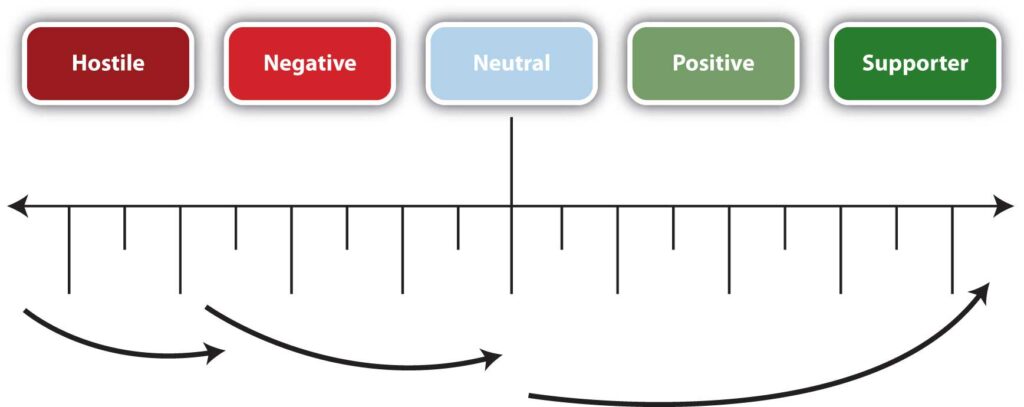
Rather than view this speech as a means to get everyone to agree with you, look at the concept of measurable gain, a system of assessing the extent to which audience members respond to a persuasive message. You may reinforce existing beliefs in the members of the audience that agree with you and do a fine job of persuasion. You may also get hostile members of the audience to consider one of your arguments, and move from a hostile position to one that’s more neutral or ambivalent. The goal in each case is to move the audience members toward your position. Some change may be small but measurable, and that’s considered gain. The next time a hostile audience member considers the issue, they may be more open to it. Figure 14.1 “Measurable Gain” is a useful diagram to illustrate this concept.
Edward Hall also underlines this point when discussing the importance of context.[10]. The situation in which a conversation occurs provides a lot of meaning and understanding for the participants in some cultures. In Japan, for example, the context, such as a business setting, says a great deal about the conversation and the meaning of the words and expressions within that context. In the United States, however, the concept of a workplace or a business meeting is less structured, and the context offers less meaning and understanding.
Cultures that value context highly are aptly called high-context cultures. Those that value context to a lesser degree are called low-context cultures. These divergent perspectives influence the process of persuasion and are worthy of your consideration when planning your speech. If your audience is primarily high-context, you may be able to rely on many cultural norms as you proceed. Still, in a low-context culture, like the United States, you’ll be expected to provide structure and clearly outline your position and expectations. This ability to understand motivation and context is key to good communication, and one we’ll examine throughout this chapter.
Pro Tip: Treat “Total Victory” as a Warning Sign
When speakers walk into a persuasive situation expecting a clean sweep — every audience member converted, every councilor voting yes — they tend to overreach, push harder than the room can absorb, and lose the small gains they could have made. A more experienced speaker walks in with a written whip count: who is already with me, who is already against me, and who is movable. The question is never “can I win everyone?” It is “which two or three people are actually in play tonight, and what is the smallest move I can ask them to make?” Persuasion that succeeds is almost always persuasion that asks for the right size of change from the right size of audience.
Key Takeaways
Exercises
- Select an online advertisement that you find particularly effective or ineffective. Why does it succeed, or fail, in persuading you to want to buy the advertised product? Discuss your ideas with your classmates.
- Think of a social issue, a widely held belief, or a political position where change has occurred in your lifetime, or where you’d like to see change happen. What kinds of persuasion and motivation were involved—or would need to happen—to produce measurable gain? Explain your thoughts to a classmate.
- Think of a time when someone tried to persuade you to do something you didn’t want to do. Did their persuasion succeed? Why or why not? Discuss the event with a classmate.
- Case Application: Mirembe’s whip count is two yes, two undecided, three no. Map that whip count onto the measurable gain spectrum in Figure 14.1. Which councilors does she need to move how far to get to five votes, and which councilors should she consciously decide not to try to move?
- Case Application: Asa tells Mirembe not to try to flip Ron on parking because “parking is not a policy position for Ron, it is an inheritance.” Rewrite that observation in the language of persuasion versus motivation. What is Ron’s motivation, and how does recognizing it change Mirembe’s persuasive strategy?
14.2 Principles of Persuasion
Learning Objectives
- Identify Cialdini’s six principles of persuasion and define each in your own words.
- Apply each principle to a real-world persuasive scenario of your choosing.
- Recognize when each principle is being used on you and evaluate whether the use is ethical.
- Combine two or more principles into a single persuasive move and explain why combinations often outperform solo principles.
What’s the best way to succeed in persuading your listeners? There’s no one “correct” answer, but many experts have studied persuasion and observed what works and what doesn’t. Social psychologist Robert Cialdini offers us six principles of persuasion that are powerful and effective:[11]
- Reciprocity
- Scarcity
- Authority
- Commitment and consistency
- Consensus
- Liking
You’ll find these principles both universal and adaptable to a myriad of contexts and environments. Recognizing when each principle is in operation will allow you to leverage the inherent social norms and expectations to your advantage and enhance your sales position.
Principle of Reciprocity
Reciprocity is the mutual expectation for the exchange of value or service. In all cultures, when one person gives something, the receiver is expected to reciprocate, even if only by saying “thank you.” There’s a moment when the giver has power and influence over the receiver, and if the exchange is dismissed as irrelevant by the giver, the moment is lost. In business, this principle has several applications. Suppose you’re in customer service and go out of your way to meet the customer’s need. In that case, you’re appealing to the principle of reciprocity with the knowledge that all humans perceive the need to reciprocate—in this case, by increasing the likelihood of purchasing from you because you were especially helpful. Reciprocity builds trust and the relationship develops, reinforcing everything from personal to brand loyalty. By taking the lead and giving, you create a moment where people will feel compelled from social norms and customs to give back.
Principle of Scarcity
You want what you can’t have, and it’s universal. People are naturally attracted to the exclusive, the rare, the unusual, and the unique. If they’re convinced that they need to act now or it will disappear, they’re motivated to action. Scarcity is the perception of inadequate supply or a limited resource. For a sales representative, scarcity may be a key selling point—the particular car, or theater tickets, or pair of shoes you’re considering may be sold to someone else if you delay making a decision. By reminding customers not only of what they stand to gain but also of what they stand to lose, the representative increases the chances that the customer will make the shift from contemplation to action and decide to close the sale.
Principle of Authority
Trust is central to the purchase decision. Whom does a customer turn to? A salesperson may be part of the process, but an endorsement by an authority holds credibility that no one with a vested interest can ever attain. Knowledge of a product, field, trends in the field, and even research can make a salesperson more effective by appealing to the principle of authority. It may seem like extra work to educate your customers, but you need to reveal your expertise to gain credibility. We can borrow a measure of credibility by relating what experts have indicated about a product, service, market, or trend, and our awareness of competing viewpoints allows us insight that’s valuable to the customer. Reading the manual of a product isn’t sufficient to gain expertise—you have to do extra homework. The principle of authority involves referencing experts and expertise.
Principle of Commitment and Consistency
Oral communication can be slippery in memory. What we said at one moment or another, unless recorded, can be hard to recall. Even a handshake, once the symbol of agreement across almost every culture, has lost some of its symbolic meaning and social regard. In many cultures, the written word holds special meaning. If we write it down or if we sign something, we’re more likely to follow through. By extension, even if the customer won’t be writing anything down, if you do so in front of them, it can appeal to the principle of commitment and consistency and bring the social norm of honoring one’s word to bear at the moment of purchase.
Principle of Consensus
Testimonials, or first-person reports on experience with a product or service, can be highly persuasive. People often look to each other when making a purchase decision, and the herd mentality is a powerful force across humanity. If “everybody else” thinks this product is great, it must be great. We often choose the path of the herd, particularly when we lack adequate information. Leverage testimonials from clients to attract more clients by making them part of your team. The principle of consensus involves the tendency of the individual to follow the lead of the group or peers.
Principle of Liking
Safety is the twin of trust as a foundation element for effective communication. If we feel safe, we’re more likely to interact and communicate. We tend to be attracted to people who tell us they like us and make us feel good about ourselves. Given a choice, these are the people with whom we’re likely to associate. Physical attractiveness has long been known to be persuasive, but similarity is also quite effective. We’re drawn to people who are like us, or whom we perceive as being like us, and often make those judgments based on external characteristics like dress, age, sex, race, ethnicity, and perceptions of socioeconomic status. The principle of liking involves the perception of safety and belonging in communication.
Case Connection: Asa’s Four Principles in Six Minutes
In her six-minute phone call, Asa Fitzhugh-Ndlovu hands Mirembe four of Cialdini’s six principles and tells her how to use them without ever naming them. Reciprocity: thank Ron for the 1993 ordinance before asking him for anything. Scarcity: frame the bike network as something the city will either build in this bond cycle or not build for at least a decade. Consensus: bring three testimonies and six teenagers whose presence communicates “this is already happening, and a movement is waiting for you to catch up.” Commitment and consistency: let Ron remember his own yes vote on Providence 2030 without being told to. Note what Asa does not recommend: she does not tell Mirembe to rely on authority (crash statistics) or liking (being charming). Experienced persuaders know that principles are tools, and that some tools are right for some rooms.
Common Mistake: Using Authority as a Substitute for Relationship
New speakers often lean on the principle of authority — citing experts, studies, statistics — because it feels safer than the relational principles (reciprocity, consensus, liking). Authority is a real and powerful principle, but audiences can tell when a speaker is hiding behind their sources. If every other sentence begins “According to a 2024 study…” the audience starts to suspect that the speaker does not have a personal stake in the claim, only a citation for it. Use authority to reinforce what you have already said in your own voice, not to substitute for it.
Key Takeaways
Exercises
- Think of a real-life example of the principle of scarcity being used in a persuasive message. Were you the one trying to persuade someone, or were you the receiver of the scarcity message? Was the message effective? Discuss your thoughts with a classmate.
- Do you think the principle of consensus often works—are people often persuaded to buy things because other people own that item, or are going to buy it? Are you susceptible to this kind of persuasion? Think of some examples and discuss them with classmates.
- Do people always use reason to make decisions? Support your opinion and discuss it with classmates.
- Make a list of five or six people you choose to associate with—friends, neighbors, and coworkers, for example. Next to each person’s name, write the characteristics you have in common with that person. Do you find that the principle of liking holds true in your choice of associates? Why or why not? Discuss your findings with your classmates.
- Case Application: Identify the one Cialdini principle that Mirembe’s original data-case draft relied on most heavily. Then identify which two or three principles that draft completely omitted. How does that imbalance help explain why the data case “made her feel like she was losing a court case” when she read it aloud?
14.3 Functions of the Presentation to Persuade
Learning Objectives
- Identify and demonstrate the effective use of the five functions of speaking to persuade.
- Distinguish among adoption, discontinuance, deterrence, and continuance as goals of action.
- Decide which function best matches a given audience analysis and persuasive context.
- Develop solution steps that move from national to local to personal level in a single coherent call to action.
- Explain why a single speech can legitimately pursue more than one function at once.
What does a presentation to persuade do? There’s a range of functions to consider, and they may overlap or you may incorporate more than one as you present. We’ll discuss how to
- stimulate,
- convince,
- call to action,
- increase consideration, and
- develop tolerance of alternate perspectives.
We’ll also examine how each of these functions influences the process of persuasion.
Stimulate
When you focus on stimulation as the goal or operational function of your speech, you want to reinforce existing beliefs, intensify them, and bring them to the forefront. Perhaps you’ve been concerned with global warming for quite some time. Many people in the audience may not know about the melting polar ice caps and the loss of significant ice shelves in Antarctica, including part of the Ross Ice Shelf, an iceberg almost 20 miles wide and 124 miles long, more than twice the size of Rhode Island. They may be unaware of how many ice shelves have broken off, the 6 percent drop in global phytoplankton (the basis of many food chains), and the effects of the introduction of fresh water to the oceans. By presenting these facts, you’ll reinforce existing beliefs, intensify them, and bring the issue to the surface. You might consider the foundation of common ground and commonly held beliefs, and then introduce information that a mainstream audience may not be aware of that supports that common ground as a strategy to stimulate.
Convince
In a persuasive speech, the goal is to change the attitudes, beliefs, values, or judgments of your audience. If we look back at the idea of motive, in this speech, the prosecuting attorney would try to convince the jury members that the defendant is guilty beyond a reasonable doubt. They may discuss motive, present facts, all with the goal to convince the jury to believe or find that their position is true. In a modern documentary like Chasing Ice or a docuseries on a streaming service about climate change, a scientist might present evidence of climate change, but face resistance from powerful figures who hold a different view.
Audience members will also hold beliefs and are likely to be influenced by their own bias. Your goal is to get them to agree with your position, so you’ll need to plan a range of points and examples to get audience members to consider your topic. Perhaps you present Dennis Quaid’s argument that the loss of the North Atlantic Current will drastically change our climate, clearly establishing the problem for the audience. You might cite the review by a professor, for example, who states in a reputable science magazine that the film’s depiction of climate change is plausible, but that the timetable is more on the order of ten years, not seven days as depicted in the film. You then describe a range of possible solutions. If the audience comes to a mental agreement that a problem exists, they’ll look to you, asking, “What are the options?” Then you may indicate a solution that’s a better alternative, recommending future action.
Call to Action
In this speech, you’re calling your audience to action. You’re stating that it’s not about stimulating interest to reinforce and accentuate beliefs, or convincing an audience of a viewpoint that you hold, but instead that you want to see your listeners change their behavior. If you were in sales at Toyota, you might incorporate our previous example on global warming to reinforce, and then make a call to action (make a purchase decision) when presenting the Prius hybrid (gas-electric) automobile. The economics, even at current gas prices, might not completely justify the price difference between a hybrid and a nonhybrid car. However, if you, as the salesperson, can make a convincing argument that choosing a hybrid car is the right and responsible decision, you may be more likely to get the customer to act. The persuasive speech that focuses on action often generates curiosity, clarifies a problem, and, as we’ve seen, proposes a range of solutions. The key difference here is that there’s a clear link to action associated with the solutions.
Solutions lead us to consider the goals of action. These goals address the question, “What do I want the audience to do as a result of being engaged by my speech?” The goals of action include adoption, discontinuance, deterrence, and continuance.
Adoption means the speaker wants to persuade the audience to adopt a new way of thinking or a new idea. Examples could include buying a new product, voting for a new candidate, or donating blood. The key is that the audience member adopts, or takes on, a new view, action, or habit.
Discontinuance involves the speaker persuading the audience to stop doing something that they’ve been doing, such as smoking. Rather than take on a new habit or action, the speaker is asking the audience member to stop an existing behavior or idea. As such, discontinuance is in some ways the opposite of adoption.
Deterrence is a call to action that focuses on persuading the audience not to start something if they haven’t already started. Perhaps many people in the audience have never tried illicit drugs, or haven’t gotten behind the wheel of a car while intoxicated. The goal of action in this case would be to deter or encourage the audience members to refrain from starting or initiating the behavior.
Finally, with continuance, the speaker aims to persuade the audience to continue doing what they’ve been doing, such as reelecting a candidate, continuing to buy a product, or staying in school to get an education.
A speaker may choose to address more than one of these goals of action, depending on the audience analysis. If the audience is largely agreeable and supportive, you may find continuance to be one goal, while adoption is secondary.
These goals serve to guide you in the development of solution steps. Solution steps involve suggestions or ways the audience can take action after your speech. They often proceed from national to personal level, or vice versa. Audience members appreciate a clear discussion of the problem in a persuasive speech, but they also appreciate solutions. You might offer a national solution that may be viewed as unworkable. Still, your solution on a personal level may be more realistic, such as considering an alternate point of view or making a small donation to a worthy cause.
Increase Consideration
Perhaps you know that your audience isn’t open to emotional appeals that involve the fear of global warming, so you choose to base your persuasive speech on something they’re more open to: the economic argument and the relative cost of car ownership. In this speech, you want to increase consideration on the part of the audience, whose members either hold hostile views or perhaps are neutral and simply curious. You might be able to compare and contrast competing cars and show that the costs over ten years are quite similar, but that the Prius has additional features that are the equivalent of a bonus, including high gas mileage. You might describe tax incentives for ownership, maintenance schedules and costs, and resale value. Your arguments and their support aim at increasing the audience’s consideration of your position. You won’t be asking for action in this presentation, but a corresponding increase of consideration may lead the customer to that point at a later date.
Develop Tolerance of Alternate Perspectives
Finally, you may want to help your audience develop tolerance of alternate perspectives and viewpoints. Perhaps your audience, as in the previous example, is interested in purchasing a car, and you’re the lead salesperson on that model. As you listen and do your informal audience analysis, you may learn that horsepower and speed are essential values to this customer. You might raise the issue of torque versus horsepower and indicate that the “uumph” you feel as you start a car off the line is torque. Many hybrid and even electric vehicles have great torque, as their systems involve fewer parts and less friction than a corresponding internal combustion-transaxle system. Your goal is to help your audience develop tolerance, but not necessarily acceptance, of alternate perspectives. A traditional way of measuring speed has always been how fast a car can go from zero to sixty miles per hour.
You’re essentially indicating that there are two relevant factors to consider when discussing speed (horsepower and torque), and asking the customer to consider the alternate perspective. Lots of horsepower might be all right for high speeds, but by raising the issue of their normal driving, they might learn that what counts day in and day out for driving is torque, not horsepower. By starting from common ground and introducing a related idea, you’re persuading your audience to consider an alternate perspective.
Case Connection: Mirembe’s Speech Is Four Functions in One
Once Mirembe throws out her three drafts, the speech she walks into the chamber with turns out to be doing four of the five functions at once. For Councilors Trethewey-Abdulkadir and Stensgaard-Chatterjee (the two yes votes) it is a stimulation speech — reinforcing and intensifying what they already believe. For Chair Gorski-Abumrad and Councilor Boruszko-Taiwo (undecided) it is a conviction speech — moving them from neutral to positive. For the public in the chamber it is a call to action — explicit solution steps at national, state, and personal levels. And for Ron Petraki-Wheldon (presumed no) it is an increase-consideration speech — not asking him to become a cyclist but asking him to remember that he once asked his constituents to give something up for the neighborhood. Four functions, one speech, twelve minutes. Experienced persuaders do this routinely.
Pro Tip: Know the Function Before You Know the Content
A common mistake is to write the body of a persuasive speech first and then try to decide what function it is supposed to serve. The result is usually a speech that pretends to be a call to action but is actually a stimulation speech, or a speech that pretends to convince but is really asking for continuance. Decide the function first, then write. If you cannot answer the question “what specifically do I want each segment of this audience to do, feel, or consider differently when they walk out of this room?” before you start writing, you are not ready to write yet.
Key Takeaways
Exercises
- Select a commercial for a product or service you don’t believe you’d ever buy. Evaluate the commercial according to the principles of persuasion described in this section. Does it use more than one principle? Is any principle effective on you as an audience member? If you could change the commercial to increase its persuasive appeal to yourself as a customer, what changes would you make? Discuss your findings with your classmates.
- Which do you think is a more difficult challenge, discontinuance or deterrence? Why? Give some examples and discuss them with your classmates.
- Do you think persuasion by continuance is necessary? Or would people continue a given behavior regardless of any persuasive messages? Think of an example and discuss it with your classmates.
- Case Application: Mirembe has six teenagers from the earn-a-bike program sitting in the back row but decides not to introduce them until minute nine. What function of persuasion is served by the teenagers’ presence, and why is the delayed introduction a more persuasive choice than introducing them in the first sixty seconds?
14.4 Meeting the Listener’s Basic Needs
Learning Objectives
- Identify and describe several basic needs that people seek to fulfill when they communicate.
- Explain each of Maslow’s seven categories of need and relate them to persuasive messaging.
- Apply social penetration theory to plan the level of self-disclosure appropriate for a given persuasive situation.
- Recognize the “iceberg” metaphor for self-disclosure and use it to diagnose why some persuasive appeals feel shallow.
In this section, we’ll examine why we communicate, illustrating how meeting the listener’s basic needs is central to effective communication. It’s normal for the audience to consider why you’re persuading them, and there’s significant support for the notion that by meeting the audience’s basic needs, whether they’re a customer, colleague, or supervisor, you’ll more effectively persuade them to consider your position.
Not all oral presentations involve taking a position or overt persuasion, but all focus on the inherent relationships and basic needs within the business context. Getting someone to listen to what you have to say involves a measure of persuasion, and getting that person to act on it might require considerable skill. Whether you’re persuading a customer to try a new product or service or informing a supplier that you need additional merchandise, the relationship is central to your communication. The emphasis inherent in our next two discussions is that we all share this common ground, and by understanding that we share basic needs, we can better negotiate meaning and achieve understanding.
Table 14.1 “Reasons for Engaging in Communication,” presents some reasons for engaging in communication. As you can see, the final item in the table indicates that we communicate to meet our needs. What are those needs? We’ll discuss them next.
| Review | Why We Engage in Communication |
|---|---|
| Gain Information | We engage in communication to gain information. This information can involve directions to an unknown location, or a better understanding about another person through observation or self-disclosure. |
| Understand Communication Contexts | We also want to understand the context in which we communicate, discerning the range between impersonal and intimate, to better anticipate how to communicate effectively in each setting. |
| Understand Our Identity | Through engaging in communication, we come to perceive ourselves, our roles, and our relationships with others. |
| Meet Our Needs | We meet our needs through communication. |
Maslow’s Hierarchy
If you’ve taken courses in anthropology, philosophy, psychology, or perhaps sociology in the past, you may have seen Maslow’s hierarchy of needs (Figure 14.3 “Maslow’s Hierarchy”). Psychologist Abraham Maslow provides seven basic categories for human needs, and arranges them in order of priority, from the most basic to the most advanced.[12]
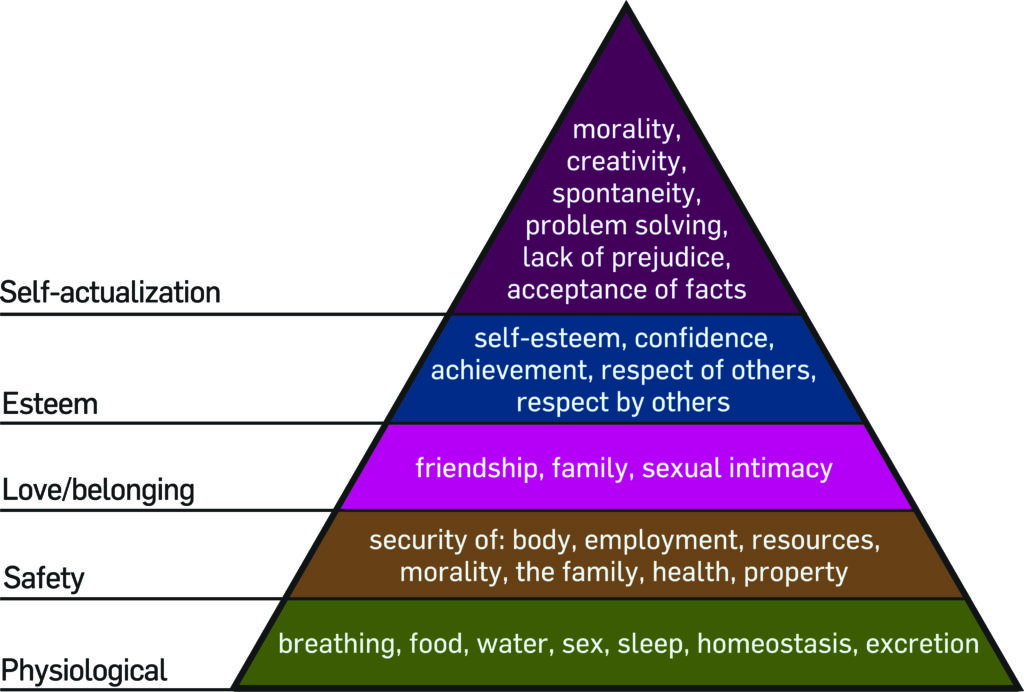
In this figure, we can see that we need energy, water, and air to live. Without any of these three basic elements, which meet our physiological needs (1), we can’t survive. We need to meet them before anything else, and will often sacrifice everything else to get them. Once we have what we need to live, we seek safety (2). A defensible place, protecting your supply lines for your most basic needs, could be your home. For some, however, home is a dangerous place that compromises their safety. Children and victims of domestic violence need shelter to meet this need. To leave a hostile living environment, people may place the well-being and safety of another over their own needs, thereby putting themselves at risk. An animal would fight for its survival above all else, but humans can and do acts of heroism that directly contradict their self-interest. Our own basic needs motivate us, but sometimes the basic needs of others are more important to us than our own.
We seek affection from others once we have the basics to live and feel safe from immediate danger. We look for a sense of love and belonging (3). All needs in Maslow’s model build on the foundation of the previous needs, and the third level reinforces our need to be a part of a family, community, or group. This is an important step that directly relates to business communication. If a person feels safe at your place of business, they’re more likely to be open to communication. Communication is the foundation of the business relationship, and without it, you’ll fail. If they feel on edge, or that they might be pushed around, made to feel stupid, or even unwanted, they’ll leave, and your business will disappear. On the other hand, if you make them feel welcome, provide multiple ways for them to learn, educate themselves, and ask questions in a safe environment, you’ll form relationships that transcend business and invite success.
Once we’ve been integrated into a group, we begin to assert our sense of self and self-respect, addressing our need for self-esteem (4). Self-esteem is essentially how we feel about ourselves. Let’s say you’re a male, but you weren’t born with a “fix-it” gene. It’s nothing to be ashamed of, but for many men it can be hard to admit. We no longer live in a time when we have to build our own houses or learn about electricity and plumbing as we grow up, and if it’s not part of your learning experience, it’s unreasonable to expect that you’ll be handy with a wrench from the first turn.
The do-it-yourself chain Home Depot may have recognized how this interest in home repair is paired with many men’s reluctance to admit their lack of experience. They certainly turned it into an opportunity. Each Saturday around the country, home repair clinics on all sorts of tasks, from cutting and laying tile to building a bird house, are available free to customers at Home Depot stores. You can participate, learn, gain mastery of a skill set, and walk out of the store with all the supplies you need to get the job done. You’ll also now know someone (the instructor, a Home Depot employee) whom you can return to for follow-up questions. Ultimately, if you fail in getting the job done right, they’ll help you arrange for professional installation. This model reinforces safety and familiarity, belonging to a group or perceiving a trustworthy support system, and the freedom to make mistakes. It’s an interactive program that squarely addresses one of the customers’ basic human needs.
Maslow discusses the next level of needs in terms of how we feel about ourselves and our ability to assert control and influence over our lives. Once we’re part of a group and have begun to assert ourselves, we start to feel as if we’ve reached our potential and are actively making a difference in our world. Maslow calls this self-actualization (5). Self-actualization can involve reaching your full potential, feeling accepted for who you are, and perceiving a degree of control or empowerment in your environment. It may mean the freedom to go beyond building the bird house to the tree house, and to design it yourself as an example of self-expression.
As we progress beyond these levels, our basic human curiosity about the world around us emerges. When we have our basic needs met, we don’t need to fear losing our place in a group or access to resources. We’re free to explore and play, discovering the world around us. Our need to know (6) motivates us to grow and learn. You may have taken an elective art class that sparked your interest in a new area, or you started a new sport or hobby, like woodworking. If you worked at low-paying jobs that earned you barely enough to meet your basic needs, you may not be able to explore all your interests. You might be too exhausted after sixty or seventy hours a week on a combination of the night shift and the early morning shift across two jobs. If you didn’t have to work as many hours to meet your more basic needs, you’d have time to explore your curiosity and address the need to learn. Want to read a good book? You’d have the time. Want to take a watercolor class? Sounds interesting. If, however, we’re too busy hunting and gathering food, there’s little time for contemplating beauty.
Beyond curiosity lies the aesthetic need to experience beauty (7). Form is freed from function, so that a wine bottle opener can be appreciated for its clever design that resembles a rabbit’s head instead of simply how well it works to remove the cork. The appreciation of beauty transcends the everyday, the usual; it becomes exceptional. You may have walked into a building or church and become captivated by the light, the stained-glass windows, or the design. That moment that transcends the mundane, that stops you in your tracks, comes close to describing the human appreciation for the aesthetic, but it’s really up to you.
We can see in Maslow’s hierarchy how our most basic needs are quite specific. As we progress through the levels, the level of abstraction increases until ultimately we’re freed from the daily grind to contemplate the meaning of a modern painting. As we increase our degree of interconnectedness with others, we become interdependent and, at the same time, begin to express independence and individuality. As a speaker, you may seek the safety of the familiar, only to progress with time and practice to a point where you make words your own.
Your audience will share with you a need for control. You can help meet this need by constructing your speech with an effective introduction, references to points you’ve discussed, and a clear conclusion. The introduction will set up audience expectations of the points you’ll consider, and allow the audience to see briefly what’s coming. Your internal summaries, signposts, and support of your main points all serve to remind the audience what you’ve discussed and what you’ll discuss. Finally, your conclusion answers the inherent question, “Did the speaker actually talk about what they said they were going to talk about?” and affirms to the audience that you’ve fulfilled your objectives.
Case Connection: Parking as a Safety Need
Ron Petraki-Wheldon’s twenty-year fight for parking on Federal Hill is usually discussed as a policy preference. Read through the Maslow lens, though, it is a safety argument. When Ron’s constituents cannot park near their homes, they walk further at night, their groceries sit in their cars longer, their elderly parents cannot visit, and their sense of a defensible place — Maslow’s level two — is disrupted. Mirembe’s insight in listening to Asa is that she was prepared to argue level-five and level-six needs (self-actualization, need to know) at a council where two members were still working on level-two needs for their constituents. Persuasion that tries to skip levels fails. Persuasion that names the level below the one it is asking for tends to succeed.
Social Penetration Theory
The field of communication draws from many disciplines, and in this case, draws lessons from two prominent social psychologists. Irwin Altman and Dalmas Taylor articulated the social penetration theory, which describes how we move from superficial talk to intimate and revealing talk.[13] Altman and Taylor discuss how we attempt to learn about others so that we can better understand how to interact.[14] With a better understanding of others and with more information, we’re in a better position to predict how they may behave, what they may value, or what they might feel in specific situations. We usually gain this understanding of others without thinking about it through observation or self-disclosure. In this model, often called the “onion model,” we see how we start out on superficial level, but as we peel away the layers, we gain knowledge about the other person that encompasses both breadth and depth.
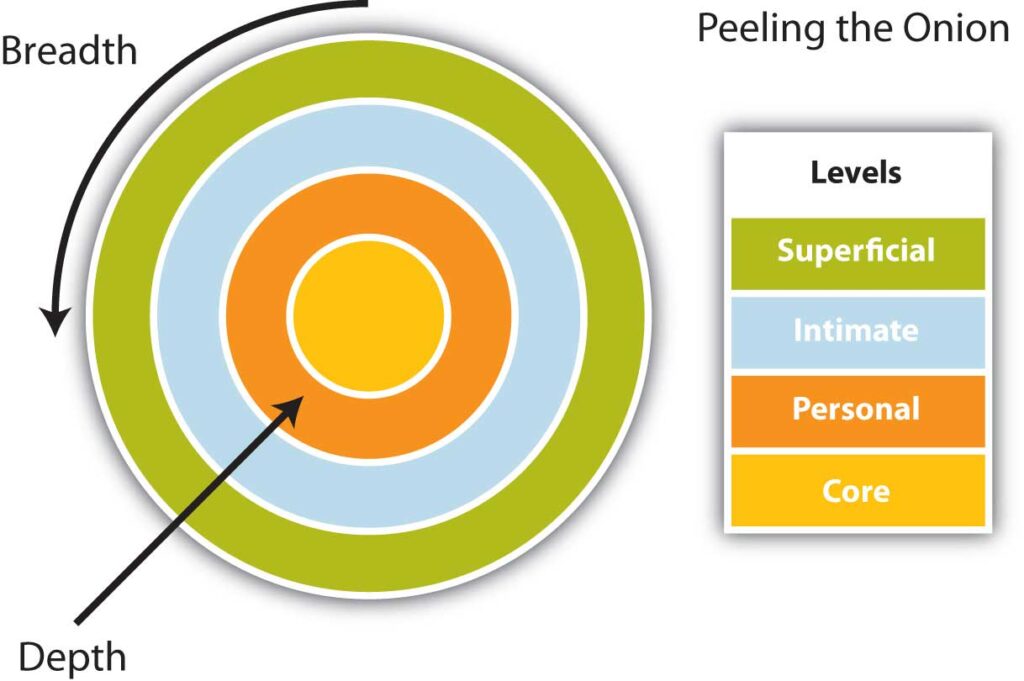
We come to know more about the way a person perceives a situation (breadth), but also gain perspective into how they see the problem through an understanding of their previous experiences (depth). Imagine these two spheres, which represent people, coming together. What touches first? The superficial level. As the two start to overlap, the personal levels may touch, then the intimate level, and finally, the core levels may even touch. Have you ever known a couple—perhaps your parents or grandparents—who’ve been together for a very long time? They know each other’s stories and finish each other’s sentences. They might represent the near overlap, where their core values, attitudes, and beliefs are similar through a lifetime of shared experiences.
We move from public to private information as we progress from small talk to intimate conversations. Imagine an onion. The outer surface can be peeled away, and each new layer reveals another until you arrive at the heart of the onion. People interact on the surface, and only remove layers as trust and confidence grow.
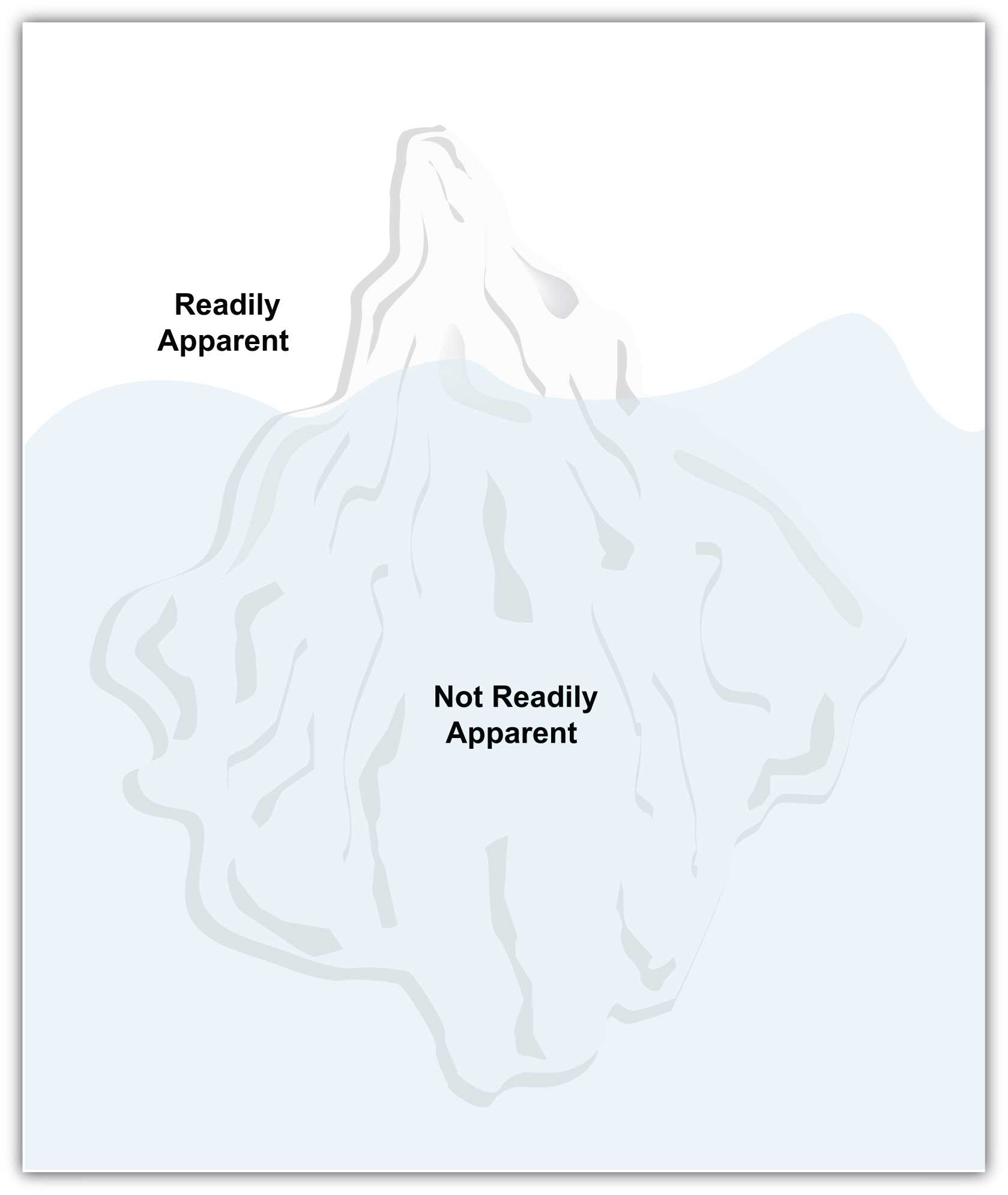
Another way to look at it is to imagine an iceberg. How much of the total iceberg can you see from the surface of the ocean? Not much. But once you start to look under the water, you gain an understanding of the large size of the iceberg, and the extent of its depth. We have to go beyond superficial understanding to know each other, and progress through the process of self-disclosure to come to know and understand one another. See Figure 14.5 “American Foreign Service Manual Iceberg Model” for an illustration of an “iceberg model” adapted from the American Foreign Service Manual.[15] This model has existed in several forms since the 1960s, and serves as a useful illustration of how little we perceive of each other with our first impressions and general assumptions.
Reflection Write: What Do Your Councilors Know About You?
Think of a persuasive situation you are about to walk into — a request to a supervisor, a pitch to a classroom, a family decision you want to influence. List the three people whose opinion matters most in that situation. For each one, write two sentences answering: what do they know about you at the superficial level, and what do they know about you at the personal level? Now ask yourself which of those layers you are about to rely on. Speakers who try to persuade from a level their audience has not given them permission to use tend to come across as presumptuous. Speakers who stay strictly on the superficial level tend to come across as insincere. The persuasive sweet spot is the deepest layer your audience has actually granted you access to — and no deeper.
Key Takeaways
Exercises
- Consider your life in relation to Maslow’s hierarchy of needs. To what degree do you feel you’ve attained the different levels in the hierarchy? Two or three years ago, were you at the same level where you currently are, or has your position in the hierarchy changed? In what ways do you expect it to change in the future? Discuss your thoughts with your classmates.
- Think of someone you’ve met but don’t know very well. What kinds of conversations have you had with this person? How might you expect your conversations to change if you have more opportunities to get better acquainted? Discuss your thoughts with a classmate.
- Think of a conversation you’ve had within the past day. What were the reasons for having that conversation? Can you relate it to the reasons for engaging in conversation listed in Table 14.1 “Reasons for Engaging in Communication”? Discuss your thoughts with a classmate.
- Write a brief paragraph about getting to know someone. Discuss whether, in your experience, it followed the social penetration theory. Share and compare with classmates.
- Case Application: Ron Petraki-Wheldon and Mirembe have never had a private conversation. Using social penetration theory, what level of disclosure does Mirembe have the right to use in her public testimony about Ron — superficial, personal, intimate, or core? How does her reference to his 1993 ordinance stay within, or push past, that line?
14.5 Making an Argument
Learning Objectives
- Label and discuss three components of an argument.
- Identify and provide examples of emotional appeals.
- Distinguish the six steps of classical rhetorical strategy from Toulmin’s three-part model and explain what each model makes visible.
- Apply the GASCAP/T framework to diagnose the argumentative strategies in a persuasive message you encounter.
- Evaluate evidence for supportiveness, relevance, and effectiveness using the “so what?” test.
According to the famous satirist Jonathan Swift, “Argument is the worst sort of conversation.” You may be inclined to agree. When people argue, they’re engaged in conflict, and it’s usually not pretty. It sometimes appears that way because people resort to fallacious arguments or false statements, or they don’t treat each other with respect. They get defensive, try to prove their points, and fail to listen to each other.
But this shouldn’t be what happens in a persuasive argument. Instead, when you make an argument in a persuasive speech, you’ll want to present your position with logical points, supporting each point with appropriate sources. You’ll want to give your audience every reason to perceive you as an ethical and trustworthy speaker. Your audience will expect you to treat them with respect, and to present your argument in a way that doesn’t make them defensive. Contribute to your credibility by building sound arguments and using strategic arguments with skill and planning.
In this section, we’ll briefly discuss the classic form of an argument, a more modern interpretation, and finally, seven basic arguments you may choose to use. Imagine that each is a tool in your toolbox, and that you want to know how to use each effectively. Know that people who try to persuade you, from telemarketers to politicians, usually have these tools at hand.
Let’s start with a classical rhetorical strategy, as shown in Table 14.2 “Classical Rhetorical Strategy”. It asks the rhetorician, speaker, or author to frame arguments in six steps.
| Concept | Definition |
| 1. Exordium | Prepares the audience to consider your argument |
| 2. Narration | Provides the audience with the necessary background or context for your argument |
| 3. Proposition | Introduces your claim being argued in the speech |
| 4. Confirmation | Offers the audience evidence to support your argument |
| 5. Refutation | Introduces to the audience and then discounts or refutes the counterarguments or objections |
| 6. Peroration | Your conclusion of your argument |
The classical rhetorical strategy is a standard pattern, and you’ll probably see it in both speech and English courses. The pattern is helpful to guide you in preparing your speech and can serve as a valuable checklist to ensure that you’re prepared. While this formal pattern has distinct advantages, you may not see it used exactly as indicated here on a daily basis. What may be more familiar to you is Stephen Toulmin’s rhetorical strategy that focuses on three main elements, shown in Table 14.3 “Toulmin’s Three-Part Rhetorical Strategy”.[16]
| Element | Description | Example |
|---|---|---|
| 1. Claim | Your statement of belief or truth | It’s important to spay or neuter your pet. |
| 2. Data | Your supporting reasons for the claim | Millions of unwanted pets are euthanized annually. |
| 3. Warrant | You create the connection between the claim and the supporting reasons | Pets that are spayed or neutered don’t reproduce, preventing the production of unwanted animals. |
Toulmin’s rhetorical strategy is helpful in that it makes the claim explicit, clearly illustrating the relationship between the claim and the data, and allows the listener to follow the speaker’s reasoning. You may have a good idea or point, but your audience will be curious and want to know how you arrived at that claim or viewpoint. The warrant often addresses the inherent and often unspoken question, “Why is this data so important to your topic?” and helps you illustrate relationships between information for your audience. This model can help you clearly articulate it for your audience.
Argumentation Strategies: GASCAP/T
Here’s a useful way of organizing and remembering the seven key argumentative strategies:
- Argument by Generalization
- Argument by Analogy
- Argument by Sign
- Argument by Consequence
- Argument by Authority
- Argument by Principle
- Argument by Testimony
Richard Fulkerson notes that a single strategy is sufficient to make an argument some of the time, but more common is an effort to combine two or more strategies to increase your powers of persuasion.[17] He organized the argumentative strategies in this way to compare the differences, highlight the similarities, and allow for their discussion. This model, often called by its acronym GASCAP, is a useful strategy to summarize six key arguments and is easy to remember. In Table 14.4 “GASCAP/T Strategies” we’ve adapted it, adding one more argument that’s often used in today’s speeches and presentations: the argument by testimony. This table presents each argument, provides a definition of the strategy and an example, and examines ways to evaluate each approach.
| Argument by | Claim | Example | Evaluation | |
|---|---|---|---|---|
| G | Generalization | Whatever is true of a good example or sample will be true of everything like it or the population it came from. | If many social media users report negative mental health effects from a platform, it’s reasonable to assume the platform has widespread negative effects. | STAR System: For it to be reliable, we need a (S) sufficient number of (T) typical, (A) accurate, and (R) reliable examples. |
| A | Analogy | Two situations, things, or ideas are alike in observable ways and will tend to be alike in many other ways. | Social media platforms are like public utilities. They’re essential for modern communication, so they should be regulated like utilities. | Watch for adverbs that end in “-ly,” as they qualify, or lessen the relationship between the examples. Words like “probably,” “maybe,” “could,” “may,” or “usually” all weaken the relationship. |
| S | Sign | Statistics, facts, or cases indicate meaning, much like a stop sign means “stop.” | Statistics show a correlation between hours spent on social media and increased rates of anxiety among teenagers. | Evaluate the relationship between the sign and look for correlation, where the presenter says what a fact “means.” Does the sign say that? Does it say more, or what isn’t said? Is it relevant? |
| C | Cause | If two conditions always appear together, they’re causally related. | The implementation of new algorithm transparency laws in Europe led to a noticeable decrease in the spread of misinformation on social media platforms. | Watch out for “after the fact, therefore because of the fact” (post hoc, ergo propter hoc) thinking. There might not be a clear connection, and it might not be the whole picture. |
| A | Authority | What a credible source indicates is probably true. | According to a study from the American Psychological Association, heavy social media use is linked to mental health issues. | Is the source legitimate and is their information trustworthy? Institutes, boards, and people often have agendas and distinct points of view. |
| P | Principle | An accepted or proper truth. | The content moderation policies of social media companies shouldn’t violate the principle of free speech, even if a user’s speech is unpopular. | Is the principle being invoked generally accepted? Is the claim, data, or warrant actually related to the principle stated? Are there common exceptions to the principle? What are the practical consequences of following the principle in this case? |
| T | Testimony | Personal experience. | I saw how a friend was cyberbullied on social media, and the experience had a lasting impact on their mental health. Let me tell you about their story in particular. | Is the testimony authentic? Is it relevant? Is it representative of others’ experiences? Use the STAR system to help evaluate the use of testimony. |
Case Connection: Which GASCAP/T Strategies Mirembe Uses
By the time Mirembe walks out of the firehouse at 7:03, her restructured twelve minutes uses five of the seven GASCAP/T strategies. Testimony: Jayla, Obadiah, and Lionel. Sign: the RIDOT crash data, but used sparingly and only after the human stories have landed. Authority: the 2024 Brookings economic multiplier study, named once. Principle: the unspoken invocation of Ron’s own 2023 yes vote on Providence 2030. Generalization: the six teenagers in the back row, each standing in for the 287 earn-a-bike graduates. She does not use argument by analogy and she deliberately does not use argument by cause, because cause claims invite “post hoc ergo propter hoc” counterattacks that O’Fearghail-Minetta would absolutely make. Experienced persuaders pick four or five strategies that reinforce each other and leave the rest in the box.
Evidence
Now that we’ve clearly outlined several argument strategies, how do you support your position with evidence or warrants? If your premise or the background from which you start is valid, and your claim is clear and clearly related, the audience will naturally turn their attention to “prove it.” This is where the relevance of evidence becomes particularly important. Here are three guidelines to consider to ensure your evidence passes the “so what?” test of significance in relation to your claim. Make sure your proof is:
- Supportive Examples are clearly representative (statistics), accurate (testimony), authoritative, and reliable.
- Relevant Examples clearly relate to the claim or topic, and you’re not comparing “apples to oranges.”
- Effective Examples are clearly the best available to support the claim, quality is preferred to quantity, and there are only a few well-chosen statistics, facts, or data.
Appealing to Emotions
While we’ve highlighted several points to consider when selecting information to support your claim, know that Aristotle strongly preferred an argument based in logic over emotion.[18] Can the same be said for your audience, and to what degree is emotion and your appeal to it in your audience a part of modern life?
Emotions are psychological and physical reactions, such as fear or anger, to stimuli that we experience as a feeling. Our feelings or emotions directly impact our point of view and readiness to communicate, but also influence how, why, and when we say things. Emotions affect not only how you say what you say, but also how you hear and what you hear. At times, emotions can be challenging to control. Emotions will move your audience, and possibly even move you, to change or act in certain ways. Marketing experts are famous for creating a need or associating an emotion with a brand or label to sell it. You’ll speak the language of your audience in your document, and may choose to appeal to emotion, but you need to consider the strategic use as a tool that has two edges.
Aristotle indicated the most effective way to persuade an audience was through the use of logic, free of emotion. He also recognized that people are often motivated, even manipulated, by the exploitation of their emotions. In our modern context, we still engage in this debate, demanding to know the facts separate from personal opinion or agenda, but see the use of emotion to sell products. If we think of the appeal to emotion as a knife, we can see it has two edges. One edge can cut your audience, and the other can cut you. If you advance an appeal to emotion in your document on spaying and neutering pets, and discuss the millions of unwanted pets that are killed each year, you may elicit an emotional response. If you use this approach repeatedly, your audience may grow weary of it, and it will lose its effectiveness. If you change your topic to the use of animals in research, the same strategy may apply. Still, repeated attempts at engaging an emotional response may backfire on you, in essence “cutting” you, and produce an adverse reaction, called emotional resistance.
Emotional resistance involves getting tired, often to the point of rejection, of hearing messages that attempt to elicit an emotional response. Emotional appeals can wear out the audience’s capacity to receive the message. As Aristotle outlined, ethos (credibility), logos (logic), and pathos (passion, enthusiasm, and emotional response) constitute the building blocks of any document. It’s up to you to create a balanced document, where you may appeal to emotion, but choose to use it judiciously.
On a related point, the use of an emotional appeal may also impair your ability to write persuasively or effectively. If you choose to present an article to persuade on the topic of suicide, and start with a photo of your brother or sister that you lost to suicide, your emotional response may cloud your judgment and get in the way of your thinking. Never use a personal story, or even a story of someone you don’t know, if the inclusion of that story causes you to lose control. While it’s important to discuss relevant topics, including suicide, you need to assess your own relationship to the message. Your documents shouldn’t be an exercise in therapy, and you’ll sacrifice ethos and credibility, even your effectiveness, if you “lose it” because you’re really not ready to discuss the issue.
As we saw in our discussion of Altman and Taylor, most relationships form from superficial discussions and grow into more personal conversations.[19] Consider these levels of self-disclosure when planning your speech to persuade so you don’t violate conversational and relational norms.
Now that we’ve outlined emotions and their role in a speech in general and a speech to persuade specifically, it’s important to recognize the principles about emotions in communication that serve us well when speaking in public. DeVito offers us five key principles to acknowledge the role emotions play in communication and offer guidelines for their expression.[20]
Emotions Are Universal
Emotions are a part of every conversation or interaction that we have. Whether or not you consciously experience them while communicating with yourself or others, they influence how you communicate. By recognizing that emotions are a component in all communication interactions, we can emphasize understanding both the content of the message and the emotions that influence how, why, and when the content is communicated.
The context, which includes your psychological state of mind, is one of the eight basic components of communication. Expression of emotions is essential, but requires the three Ts: tact, timing, and trust. If you find you’re upset and at risk of being less than diplomatic, or the timing isn’t right, or you’re unsure about the level of trust, then consider whether you can effectively communicate your emotions. By considering these three Ts, you can help yourself express your feelings more effectively.
Emotional Feelings and Emotional Expression Are Not the Same
Experiencing feelings and actually letting someone know you’re experiencing them are two different things. We experience feeling in terms of our psychological state, or state of mind, and in terms of our physiological state, or state of our body. If we experience anxiety and apprehension before a test, we may have thoughts that correspond to our nervousness. We may also have an increase in our pulse, perspiration, and respiration (breathing) rate. Our expression of feelings by our body influences our nonverbal communication, but we can complement, repeat, replace, mask, or even contradict our verbal messages. Remember that we can’t tell with any degree of accuracy what other people are feeling simply through observation, and neither can they tell what we’re feeling. We need to ask clarifying questions to improve understanding. With this in mind, plan for a time to provide responses and open dialogue after the conclusion of your speech.
Emotions Are Communicated Verbally and Nonverbally
You communicate emotions not only through your choice of words but also through the manner in which you say those words. The words themselves communicate part of your message, but the nonverbal cues, including inflection, timing, space, and paralanguage can modify or contradict your spoken message. Be aware that emotions are expressed in both ways, and pay attention to how verbal and nonverbal messages reinforce and complement each other.
Emotional Expression Can Be Good and Bad
Expressing emotions can be a healthy activity for a relationship and build trust. It can also break down trust if expression isn’t combined with judgment. We’re all different, and we all experience emotions, but how we express our feelings to ourselves and others can have a significant impact on our relationships. Expressing frustrations may help the audience realize your point of view and see things in a new light. However, expressing frustrations combined with blaming can generate defensiveness and decrease effective listening. When you’re expressing yourself, consider the audience’s point of view, be specific about your concerns, and emphasize that your relationship with your listeners is important to you.
Emotions Are Often Contagious
Have you ever felt that being around certain people made you feel better, while hanging out with others brought you down? When we interact with each other, some of our emotions can be considered contagious. If your friends decide to celebrate, you may get caught up in the energy of their enthusiasm. Thomas Joiner noted that when one college roommate was depressed, it took less than three weeks for the depression to spread to the other roommate.[21] It’s essential to recognize that we influence each other with our emotions, positively and negatively. Your emotions as the speaker can be contagious, so use your enthusiasm to raise the level of interest in your topic. Conversely, you may be subject to “catching” emotions from your audience. Your listeners may have just come from a large lunch and feel sleepy, or the speaker who gave a speech right before you may have addressed a serious issue like suicide. Considering the two-way contagious action of emotions means that you’ll need to attend to the emotions that are present as you prepare to address your audience.
Ethical Consideration: When Your Own Story Is Still Bleeding
DeVito’s point that you should not use a personal story that causes you to lose control is especially important for student speakers. If you are persuading on a topic that touches a recent loss, a recent diagnosis, a recent assault, or a recent betrayal, the most ethical thing you can do is not lead with it. Your audience will sense the rawness. They will feel, correctly, that you are asking them to manage your emotion for you, and that sense will produce emotional resistance faster than any other failure mode. Give the story eighteen months before you use it in a persuasive setting, or use it only in a low-stakes classroom exercise where the goal is to practice, not to persuade.
Key Takeaways
Exercises
- Think of a time when you’ve experienced emotional resistance. Write two or three paragraphs about your experience. Share your notes with the class.
- Which is more powerful, appeal to reason or emotion? Discuss your response with an example.
- Select a commercial or public service announcement that uses an emotional appeal. Using the information in this section, how would you characterize the way it persuades listeners with emotion? Is it effective in persuading you as a listener? Why or why not? Discuss your findings with your classmates.
- Find an example of an appeal to emotion in the media. Review and describe it in two to three paragraphs and share with your classmates.
- Case Application: Mirembe opens her speech with a photograph of Catalina Mendoza-Ferrari and then a silence. Analyze that opening in Aristotelian terms — how does it use ethos, pathos, and logos at the same time, and why would an appeal to pathos that lasted four minutes instead of forty-five seconds have weakened rather than strengthened her credibility?
14.6 Speaking Ethically and Avoiding Fallacies
Learning Objectives
- Demonstrate the importance of ethics as part of the persuasion process.
- Identify and provide examples of eight common fallacies in persuasive speaking.
- Distinguish manipulation, deception, bribery, and coercion from legitimate persuasion.
- Apply Johannesen’s eleven ethical guidelines to evaluate a persuasive message.
- Recognize fallacies when they are being used on you and respond without escalating the conflict.
What comes to mind when you think of speaking to persuade? Perhaps the idea of persuasion may bring to mind propaganda and issues of manipulation, deception, intentional bias, bribery, and even coercion. Each element relates to persuasion, but in distinct ways. In a democratic society, we’d hope that our Bill of Rights is intact and validated, and that we’d support the exercise of freedom to discuss, consider, and debate issues when considering change. We can recognize that each of these elements has a negative connotation associated with it. Why do you think that deceiving your audience, bribing a judge, or coercing people to do something against their wishes is wrong? These tactics violate our sense of fairness, freedom, and ethics.
Manipulation involves the management of facts, ideas, or points of view to play upon inherent insecurities or emotional appeals to one’s advantage. Your audience expects you to treat them with respect, and deliberately manipulating them through fear, guilt, duty, or a relationship is unethical. In the same way, deception involves the use of lies, partial truths, or the omission of relevant information to deceive your audience. No one likes to be lied to or deceived. Deception can involve intentional bias, or the selection of information to support your position while framing negatively any information that might challenge your belief.
Bribery involves the giving of something in return for an expected favor, consideration, or privilege. It circumvents the normal protocol for personal gain, and again, is a strategy that misleads your audience. Coercion is the use of power to compel action. You make someone do something they wouldn’t choose to do freely. You might threaten punishment, and people may go along with you while the “stick” is present. Still, once the threat is removed, they’ll revert to their previous position, often with new antagonism toward the person or agency that coerced them. While you may raise the issue that the ends justify the means, and you’re “doing it for the audience’s own good,” recognize the unethical nature of coercion.
As Martin Luther King Jr. stated in his advocacy of nonviolent resistance, two wrongs don’t make a right. They’re just two wrongs that violate the ethics that contribute to community and healthy relationships. Each issue certainly relates to persuasion, but you, as the speaker, should be aware of each to present an ethical persuasive speech. Learn to recognize when others try to use these tactics on you, and know that your audience will be watching to see if you try any of these strategies on them.
Eleven Points for Speaking Ethically
In his book Ethics in Human Communication, Richard Johannesen offers eleven points to consider when speaking to persuade.[22] His main points reiterate many of the points across this chapter and should be kept in mind as you prepare and present your persuasive message.
Don’t:
- use false, fabricated, misrepresented, distorted or irrelevant evidence to support arguments or claims.
- intentionally use unsupported, misleading, or illogical reasoning.
- represent yourself as informed or an “expert” on a subject when you’re not.
- use irrelevant appeals to divert attention from the issue at hand.
- ask your audience to link your idea or proposal to emotion-laden values, motives, or goals to which it’s actually not related.
- deceive your audience by concealing your real purpose, by concealing self-interest, by concealing the group you represent, or by concealing your position as an advocate of a viewpoint.
- distort, hide, or misrepresent the number, scope, intensity, or undesirable features of consequences or effects.
- use “emotional appeals” that lack a supporting basis of evidence or reasoning.
- oversimplify complex, gradation-laden situations into simplistic, two-valued, either-or, polar views or choices.
- pretend certainty where tentativeness and degrees of probability would be more accurate.
- advocate something which you yourself don’t believe in.
Aristotle said the mark of a good person, well spoken was a clear command of the faculty of observing in any given case the available means of persuasion. He discussed the idea of perceiving the many points of view related to a topic and their thoughtful consideration. Although it’s essential to be able to sense the complexity of a case, you’re not asked to be a lawyer defending a client.
In your speech to persuade, consider honesty and integrity as you assemble your arguments. Your audience will appreciate your thoughtful consideration of more than one view, your understanding of the complexity, and you’ll build your ethos, or credibility, as you present your document. Be careful not to stretch the facts or assemble them only to prove yourself, and instead prove the argument on its own merits. Deception, coercion, intentional bias, manipulation, and bribery should have no place in your speech to persuade.
Case Connection: Why Mirembe Does Not Use the Principle Draft
The third draft Mirembe shredded was her principle case — twelve minutes of reminding Ron Petraki-Wheldon of his 2023 yes vote on Providence 2030. It was true, it was accurate, it was defensible, and Asa still told her to throw it out. The reason is not ethical in Johannesen’s sense (it was not deceptive) but it was ethically adjacent. A speech whose function is “force an opponent to confront his own record in public” treats the opponent as an adversary to be cornered rather than as a partner to be recruited. That framing, even when every fact in it is true, trips two of Johannesen’s guidelines: it risks distorting the scope of the audience’s prior commitment, and it risks oversimplifying the situation into a two-valued choice. The principle draft would have won the argument and lost the vote.
Avoiding Fallacies
Fallacies are another way of saying false logic. These rhetorical tricks deceive your audience with their style, drama, or pattern, but add little to your speech in terms of substance and can actually detract from your effectiveness. There are several techniques or “tricks” that allow the speaker to rely on style without offering a substantive argument, to obscure the central message, or twist the facts to their advantage. Here we’ll examine the eight classical fallacies. You may note that some of them relate to the ethical cautions listed earlier in this section. Eight common fallacies are presented in Table 14.5 “Fallacies”. Learn to recognize these fallacies so they can’t be used against you, and so that you can avoid using them with your audience.
| Fallacy | Definition | Example |
|---|---|---|
| 1. Red Herring | Any diversion intended to distract attention from the main issue, particularly by relating the issue to a common fear. | It’s not just about the death penalty; it’s about the victims and their rights. You wouldn’t want to be a victim, but if you were, you’d want justice. |
| 2. Straw Man | A weak argument set up to be easily refuted, distracting attention from stronger arguments | What if we released criminals who commit murder after just a few years of rehabilitation? Think of how unsafe our streets would be then! |
| 3. Begging the Question | Claiming the truth of the very matter in question, as if it were already an obvious conclusion. | We know that they’ll be released and unleashed on society to repeat their crimes again and again. |
| 4. Circular Argument | The proposition is used to prove itself. Assumes the very thing it aims to prove. Related to begging the question. | Once a killer, always a killer. |
| 5. Ad Populum | Appeals to a common belief of some people, often prejudicial, and states that everyone holds this belief. Also called the Bandwagon Fallacy, as people “jump on the bandwagon” of a perceived popular view. | Most people would prefer to get rid of a few “bad apples” and keep our streets safe. |
| 6. Ad Hominem | “Argument against the man” instead of against his message. Stating that someone’s argument is wrong solely because of something about the person rather than about the argument itself. | Our representative is a drunk and a philanderer. How can we trust him on the issues of safety and family? |
| 7. Non Sequitur | “It does not follow.” The conclusion doesn’t follow from the premises. They’re not related. | Since the liberal antiwar demonstrations of the 1960s, we’ve seen an increase in convicts who got let off death row. |
| 8. Post Hoc Ergo Propter Hoc | “After this, therefore, because of this,” also called a coincidental correlation. It tries to establish a cause-and-effect relationship where only a correlation exists. | Violent death rates went down once they started publicizing executions. |
Avoid false logic and make a strong case or argument for your proposition. Finally, here’s a five-step motivational checklist to keep in mind as you bring it all together:
- Get their attention
- Identify the need
- Satisfy the need
- Present a vision or solution
- Take action
This simple organizational pattern can help you focus on the basic elements of a persuasive message when time is short and your performance is critical.
Try It: Diagnose an Ad Hominem Without Retaliating
In the closing case, Ron Petraki-Wheldon attacks Mirembe with a textbook ad hominem: “You’re a bike advocate. Of course you want bike lanes.” The temptation for most speakers is to retaliate — “you’re a parking advocate, so of course you don’t.” That escalates. Mirembe’s response instead names and absorbs the attack: “Yes, I am a bike advocate. I am also the director of the organization that has earned-a-bike 287 Providence teenagers in the last four years.” The ad hominem gets defanged because she agrees with the true part of it and then redirects attention to evidence that was not in the attacker’s frame. Next time someone throws an ad hominem at you, try this: agree with whatever piece of it is defensible, then add the evidence the attacker did not know you had.
Key Takeaways
Exercises
- Can persuasion be ethical? Why or why not? Discuss your opinion with a classmate.
- Select a persuasive article or video from a website that you feel uses unethical techniques to persuade the audience. What techniques are being used? What makes them unethical? Discuss your findings with your classmates.
- Find an example of a particularly effective scene where a character in your favorite television program is persuaded to believe or do something. Write a two- to three-paragraph description of the scene and why it was effective. Share and compare with classmates.
- Find an example of a particularly ineffective scene where a character in your favorite television program isn’t persuaded to believe or do something. Write a two- to three-paragraph description of the scene and why it was ineffective. Share and compare with classmates.
- Find an example of a fallacy in an advertisement and share it with the class.
- Find an example of a compelling argument in an advertisement and share it with the class.
- Write a two- to three-paragraph description of a persuasive message that caused you to believe or do something. Share and compare your description with classmates.
- Case Application: Identify which of Johannesen’s eleven “don’ts” Ron’s ad hominem attack violates. Then identify which of the eight fallacies Mirembe’s response — agreeing with the defensible part — refuses to commit in retaliation. What does this exchange teach about responding to a fallacy without using one?
14.7 Sample Persuasive Speech
Learning Objectives
- Understand the structural parts of a persuasive speech.
Here’s a generic sample speech in an outline form with notes and suggestions.
Attention Statement
Show a picture of a person on death row and ask the audience: does an innocent man deserve to die?
Introduction
Briefly introduce the man in an Illinois prison and explain that he was released only days before his impending death because DNA evidence (not available when he was convicted), clearly established his innocence.
A statement of your topic and your specific stand on the topic:
“My speech today is about the death penalty, and I’m against it.”
Introduce your credibility and the topic: “My research on this controversial topic has shown me that deterrence and retribution are central arguments for the death penalty, and today I’ll address each of these issues in turn.”
State your main points.
“Today I’ll address the two main arguments for the death penalty, deterrence and retribution, and examine how the governor of one state decided that since some cases were found to be faulty, all cases would be stayed until proven otherwise.”
Body
Information: Provide a simple explanation of the death penalty in case there are people who don’t know about it. Provide clear definitions of key terms.
Deterrence: Provide arguments by generalization, sign, and authority.
Retribution: Provide arguments by analogy, cause, and principle.
Case study: State of Illinois, Gov. George Ryan. Provide an argument by testimony and authority by quoting: “You have a system right now…that’s fraught with error and has innumerable opportunities for innocent people to be executed,” Dennis Culloton, spokesman for the Governor, told the Chicago Tribune. “He’s determined not to make that mistake.”
Solution steps:
- National level. “Stay all executions until the problem that exists in Illinois, and perhaps the nation, is addressed.”
- Local level. “We need to encourage our own governor to examine the system we have for similar errors and opportunities for innocent people to be executed.”
- Personal level. “Vote, write your representatives, and help bring this issue to the forefront in your community.”
Conclusion
Reiterate your main points and provide synthesis; don’t introduce new content.
Residual Message
Imagine that you’ve been assigned to give a persuasive presentation lasting five to seven minutes. Follow the guidelines in Table 14.6 “Sample Speech Guidelines” and apply them to your presentation.
| Guideline | Explanation |
| 1. Topic | Choose a product or service that interests you so much that you’d like to influence the audience’s attitudes and behavior toward it. |
| 2. Purpose | Persuasive speakers may plan to secure behavioral changes, influence thinking, or motivate action in their audience. They may state a proposition of fact, value, definition, or policy. They may incorporate appeals to reason, emotion, and/or basic needs. |
| 3. Audience | Think about what your audience might already know about your topic and what they may not know, and perhaps any attitudes toward or concerns about it. Consider how this may affect the way that you’ll present your information. You won’t be able to convert everyone in the audience from a “no” to a “yes,” but you might encourage a couple to consider “maybe.” Audiences are more likely to change their behavior if it meets their needs, saves them money, involves a small change, or if the proposed change is approached gradually in the presentation. |
| 4. Supporting Materials | Using the information gathered in your search for information, determine what’s most worthwhile, interesting, and important to include in your speech. Time limits will require that you be selective about what you use. Consider information that the audience might want to know that contradicts or challenges your claims and be prepared for questions. Use visual aids to illustrate your message. |
| 5. Organization |
|
| 6. Introduction | Develop an opening that will
|
| 7. Conclusion | The conclusion should review and/or summarize the important ideas in your speech and bring it to a smooth close. |
| 8. Delivery | The speech should be delivered extemporaneously, using speaking notes and not reading from the manuscript. Work on maximum eye contact with your listeners. Use any visual aids or handouts that may be helpful. |
Key Takeaways
Exercises
- Apply this framework to your persuasive speech.
- Prepare a three- to five-minute presentation to persuade the class.
- Review an effective presentation to persuade and present it to the class.
- Review an ineffective presentation to persuade and present it to the class.
14.8 Elevator Speech
Learning Objectives
- Discuss the basic parts of an elevator speech.
- Create an effective elevator speech.
- Adapt the five parts of a persuasive speech to fit a thirty-second format without losing substance.
An elevator speech is to oral communication what an X (formerly Twitter) post (limited to 280 characters) is to written communication. It has to engage and interest the listener, inform and/or persuade, and be memorable.[23] An elevator speech is a presentation that persuades the listener in less than thirty seconds, or around a hundred words. It takes its name from the idea that in a short elevator ride (of perhaps ten floors), carefully chosen words can make a difference. In addition to actual conversations taking place during elevator rides, other common examples include the following:
- An entrepreneur making a brief presentation to a venture capitalist or investor
- A conversation at the water cooler
- Comments during intermission at a basketball game
- A conversation as you stroll across the parking lot
Creating an Elevator Speech
An elevator speech doesn’t have to be a formal event, though it can be. An elevator speech isn’t a full sales pitch and shouldn’t be overly detailed. The idea isn’t to rattle off as much information as possible in a short time, nor to present a “canned” thirty-second advertising message, but rather to give a relaxed and genuine “nutshell” summary of one main idea. The speech can be generic and nonspecific to the audience or listener, but the more you know about your audience, the better. When you tailor your message to that audience, you zero in on your target and increase your effectiveness.[24] The emphasis is on brevity, but a good elevator speech will address several key questions:
- What’s the topic, product or service?
- Who are you?
- Who’s the target market? (if applicable)
- What’s the revenue model? (if applicable)
- What or who is the competition and what are your advantages?
Table 14.7 “Parts of an Elevator Speech” adapts the five parts of a speech to the format of the elevator speech.
| Speech Component | Adapted to Elevator Speech |
|---|---|
| Attention Statement | Hook + information about you |
| Introduction | What you offer |
| Body | Benefits; what’s in it for the listener |
| Conclusion | Example that sums it up |
| Residual Message | Call for action |
Example:
- How are you doing?
- Great! Glad you asked. I’m with (X Company) and we just received this new (product x)—it’s amazing. It beats the competition hands down for a third of the price. Smaller, faster, and less expensive make it a winner. It’s already a sales leader. Hey, if you know anyone who might be interested, call me! (Hands business card to the listener as a visual aid)
Case Connection: Mirembe’s Elevator Version
Six weeks after the bond vote, Mirembe finds herself in an actual elevator at the Rhode Island Foundation with the foundation’s program director, who has nine floors to ask what Spoke & Gear does. Mirembe has thirty seconds. She says: “I’m Mirembe Hartsfield-Kovacs — I run Spoke & Gear, the community bike cooperative in the old Engine Company 9 firehouse on Atwells. We’ve put two hundred eighty-seven Providence teenagers on earn-a-bike bicycles in the last four years, and last week the city council passed a four-point-two-million-dollar bond to build the protected lanes those kids are going to ride on. What we do not have yet is the next generation of mechanics to train the next generation of kids. If you know any retired engineers or machinists, I’d love an introduction.” Note every move: hook (the firehouse), authority (the number 287), consensus (the just-passed bond), and a specific, small, answerable call to action. Thirty seconds, five persuasive moves.
Key Takeaways
Exercises
- Pick a product or service and prepare an elevator speech (less than a hundred words, no more than thirty seconds). Rehearse the draft out loud to see how it sounds and post or present it in class.
- Find an example of an elevator speech online (YouTube, for example) and review it. Post the link and a brief summary of strengths and weaknesses. Share and compare with classmates.
- Prepare an elevator speech (no more than thirty seconds) and present to the class.
Closing Case Analysis: The Twelve-Minute Bond, Resolved
The Providence City Council chamber on the second floor of City Hall smelled, as it always did on Tuesday nights, faintly of coffee and carpet cleaner. Mirembe walked in at 7:11 p.m., signed the public-testimony sheet at slot four, and took a seat in the second row. The six teenagers from the earn-a-bike program were already seated in the back row in white Spoke & Gear t-shirts that Estela had handed out in the parking lot. Mirembe deliberately did not turn around to look at them. She had told Estela not to let them come forward until she gave the signal.
The first three public testimony slots went: a neighborhood-association president opposing a zoning variance (four minutes), a developer supporting the same variance (six minutes), and a woman whose driveway had been blocked by construction equipment for eleven days (three minutes of controlled fury). At 7:22 Chair Ximena Gorski-Abumrad looked up from the docket and said, “Dr. Hartsfield-Kovacs, you have twelve minutes.”
Mirembe walked to the podium. She set her laptop on the podium but did not open it. Instead she placed one eight-by-ten photograph face-up on the raised easel to her left and stepped back so everyone could see it. The photograph was of Mrs. Catalina Mendoza-Ferrari, sixty-seven years old, in a sun hat at what looked like a backyard barbecue, laughing at something off-camera.
“Madam Chair, members of the council, I’m going to talk to you for twelve minutes about the Federal Hill–Olneyville Protected Bike Network bond. Before I do, I want to introduce you to Mrs. Catalina Mendoza-Ferrari. She lived on Sutton Street in Olneyville and she was killed at 4:17 p.m. on August fourteenth, 2023, on Hartford Avenue, on her bicycle, riding to her grandson’s fifth birthday party. She was carrying a cake. The driver has never been identified. The cake survived. Her grandson still has the candles.”
The chamber went quiet in the particular way chambers go quiet when an opening has just landed. Mirembe held the silence for three seconds — she had counted it out in her head — and then went on.
“I am going to ask you tonight to vote yes on the four-point-two-million-dollar bond that funds Phase One of the Federal Hill–Olneyville Protected Bike Network. I know that a yes vote is hard in this chamber. I know why it is hard. And I want to start by thanking Councilor Petraki-Wheldon, because in 1993 he introduced the ordinance that created on-street permit parking in the Federal Hill residential zones.”
Ron Petraki-Wheldon’s head came up an inch. He had been tapping his pen against the edge of the bench. The pen stopped.
“That ordinance was hard,” Mirembe said. “Councilor Petraki-Wheldon went door to door on Spruce Street and Spring Street and asked his own neighbors to pay forty-five dollars a year for the right to park in front of their own houses. Some of them never forgave him. He lost friendships over that vote. And the ordinance worked. Federal Hill has parking today because thirty-three years ago one councilor was willing to ask his constituents to give up a small thing for a larger thing. Tonight I am standing here asking the same council to consider asking the same question one more time. Not about parking. About lanes.”
Ron’s pen did not move.
Mirembe turned to her body paragraphs. She told Jayla Ramirez-Hinton’s story in ninety seconds — the Brown sophomore, the Olneyville food co-op job, the hit-and-run on Hartford Avenue, the eleven weeks in a cast, the emergency-room receipt on the refrigerator. She told Obadiah Fletcher-Akinwumi’s story in ninety seconds — Manton Heights, the eleven-year-old daughter, Nathan Bishop Middle School, the wife who had made him promise in writing to testify. She told Lionel Wambua-Beaudry’s story in ninety seconds — seventy-one years old, retired Verizon lineman, heart attack three years ago, now averaging ninety minutes a day on a bicycle and out-climbing every thirty-year-old on the hill. She named three of the six crash sites in a one-mile radius of Federal Hill from the RIDOT data — one sentence each, no statistics.
At minute seven she addressed the economic argument, named the Brookings study once, and gave the per-household cost: seven dollars and forty cents a year for twenty years on a median assessed home. She named the figure and stopped talking about money.
At minute eight she said: “I want to name something the council has not asked me about yet. In 2023 this council voted seven to zero to adopt the Providence 2030 climate commitment. I am not here to remind anyone of that vote. I am here to say that the people who made that commitment three years ago, in this room, are the same people sitting here tonight. You already did the hard thing. The bond is the easy thing after.”
At minute nine Ron Petraki-Wheldon did exactly what Asa had predicted he would do. He leaned forward, tapped his microphone on, and said, “Dr. Hartsfield-Kovacs, I appreciate the presentation, but respectfully — you are a bike advocate. Of course you are going to stand up there and tell us we need more bike lanes. What do you say to the constituents of Federal Hill who are going to lose street parking on Atwells Avenue for a project that benefits people who do not even live in my ward?”
Mirembe took a breath.
“Councilor Petraki-Wheldon, yes. I am a bike advocate. I am also the executive director of a 501(c)(3) that operates out of the old Engine Company 9 firehouse on Atwells Avenue, which is in your ward, and which has put two hundred eighty-seven Providence teenagers on earn-a-bike bicycles in the last four years. Six of them are here tonight.”
She did not turn around. She just lifted her left hand, palm up, in a small gesture the six teenagers had rehearsed. Estela Wąsowska-Oyebanji, in the back row, touched the shoulder of the nearest one. Six Spoke & Gear teenagers stood up, one at a time, in the white t-shirts, and did not speak.
Chair Gorski-Abumrad made a small sound that was almost, but not quite, a cough.
Mirembe kept talking. “Two of them are your constituents, Councilor. One of them lives on Spruce Street, which is two doors down from where you grew up. Another one lives on Fowler Street and goes to the same church you go to. I am not asking you to vote yes because they are cute. I am asking you to vote yes because you already know them. You have seen them in the hallway. You have known their parents. The bond funds the infrastructure they need to ride safely from Federal Hill to the jobs they already have in Olneyville and downtown. You asked your neighbors to give something up in 1993 for the good of this neighborhood. I am asking you whether, thirty-three years later, you want to be the councilor those kids point to when their own kids ask where the bike lanes came from.”
She held the podium. The teenagers remained standing. Ron Petraki-Wheldon did not move.
At minute ten, Mirembe moved to her solution steps. “On the national level: contact your senators about the federal complete-streets funding that would match this bond at a rate of about sixty cents on the dollar. On the state level: attend the RIDOT public-comment session next Tuesday at the Cranston Street Armory. On the personal level: if you know a Providence teenager who wants to learn to fix a bike, we are at Engine Company 9, we are open Saturdays, we will teach them for free, and no question gets mocked.”
At minute eleven she synthesized. “This council adopted Providence 2030 unanimously three years ago. A yes vote on this bond is consistent with that commitment. A no vote is the opposite of it. I am not asking you to make a new decision tonight. I am asking you to make the decision you already made, one more time, with the infrastructure that would make it real.”
At minute twelve exactly she said her residual message, and she said it once: “Mrs. Mendoza-Ferrari’s grandson is seven years old. He still has the candles from his fifth birthday. When he is old enough to ride a bicycle to school, the street he will ride on will either be the one this council builds, or the one this council did not build. Thank you.”
She stepped away from the podium.
The vote came at 8:47 p.m., after two more rounds of public testimony and a fifteen-minute recess during which Ron Petraki-Wheldon stepped out into the hallway and did not return to his seat until thirty seconds before the roll. Chair Gorski-Abumrad called the roll.
Trethewey-Abdulkadir: yes.
Stensgaard-Chatterjee: yes.
O’Fearghail-Minetta: no.
Calloway-Oduor: no.
Boruszko-Taiwo: yes.
Gorski-Abumrad: yes.
Petraki-Wheldon: (a long pause; the pen tapped the bench twice) yes.
Five to two. The bond passed.
The chamber did not applaud, because the chamber never applauded. But in the second row Jup Oduya-Persson put his Swedish face in his Swedish hands. In the back row Estela Wąsowska-Oyebanji hugged the nearest earn-a-bike teenager, who turned out to be the one from Spruce Street. And Mirembe Hartsfield-Kovacs walked out of City Hall at 9:04 p.m. with her laptop bag over her shoulder and her suit jacket in her other hand and an incoming phone call from a 734 area code that she answered before she hit the sidewalk.
“Asa.”
“How many?”
“Five to two. He voted yes.”
“Of course he did,” Asa said, and her voice broke on the second word in a way Mirembe had never heard before. “Go celebrate. Call me tomorrow.”
Two days later the Providence Journal ran a profile on the vote and asked Councilor Petraki-Wheldon what had moved him. He said, on the record: “She didn’t call me an obstacle. She called me the councilor who once asked his constituents to give up something for the neighborhood. There is a photograph of me signing the 1993 ordinance on the wall of my council office. I was not going to prove her wrong in public. I knew who I wanted to be, and she reminded me of him.”
The reporter asked if he had read any of the testimony in advance. Ron said no. “The kids stood up,” he said. “That’s what I remember. The kids stood up, and I recognized two of them.”
Closing Case Analysis Questions
- Mirembe deliberately waits until minute nine to have the six teenagers stand. Map that decision onto the five functions of persuasion from Section 14.3. What function is the visual of the standing teenagers serving, and why would an opening-of-speech introduction of them have undercut that function?
- Ron’s ad hominem attack — “you are a bike advocate, of course you want bike lanes” — is textbook Table 14.5, fallacy number six. Analyze Mirembe’s response using the “Try It” framework from Section 14.6. Which parts of the attack does she agree with, which parts does she redirect, and which parts does she leave alone?
- Asa specifically told Mirembe not to remind Ron of his yes vote on Providence 2030 but to “let him remember it himself.” Mirembe almost obeys this instruction — she names the 2023 vote but frames it as “I am not here to remind anyone of that vote.” Why does that framing work where a direct reminder would have failed? What Cialdini principle is operating?
- Identify every one of Cialdini’s six principles of persuasion that is present in the closing case. For each one, name the specific sentence or moment where it is active. Which of the six is Mirembe not using, and why do you think she leaves it out?
- The closing case contains three arguments by testimony (Jayla, Obadiah, Lionel) at ninety seconds each. Using the STAR system from Table 14.4, evaluate whether those three testimonies are sufficient in number, typical of the population affected, accurate, and reliable. Where is the evidence strongest, and where is it most vulnerable to a counterargument from Councilor O’Fearghail-Minetta?
- Ron’s quote to the reporter — “I knew who I wanted to be, and she reminded me of him” — is an unusually clear statement of the Cialdini principle of commitment and consistency in action. Explain, in your own words, how a persuasive move that asks someone to act in accordance with their own prior self-image differs from a move that asks them to adopt a new position.
- The bond passes 5-2. Two councilors still vote no. Using the concept of measurable gain from Section 14.1, evaluate the outcome: did Mirembe succeed, did she fail, or did she achieve something more nuanced than either? Would your answer change if the vote had come in at 4-3 against?
- Asa’s voice “breaks on the second word” when Mirembe reports the outcome. What is that detail doing in the closing case, and what does it add that a simpler ending — “they hung up” — would have removed? Connect your answer to DeVito’s principle that emotions are contagious.
End-of-Chapter Review Questions
- Define persuasion and motivation, and explain the functional difference between them.
- What is measurable gain, and how does it change a persuasive speaker’s definition of success?
- List Cialdini’s six principles of persuasion and give one sentence of definition for each.
- What are the five functions of a persuasive presentation, and how do they differ from one another?
- Distinguish adoption, discontinuance, deterrence, and continuance as goals of action. Give one example of each.
- What are the seven levels of Maslow’s hierarchy of needs, in order?
- Name the three components of Toulmin’s rhetorical strategy and explain the function of each.
- What does the acronym GASCAP/T stand for, and why is testimony added to the original six?
- List the eight classical fallacies in Table 14.5 and give a one-sentence definition of each.
- What are the five parts of the persuasive speech structure, and how do they map onto the parts of an elevator speech?
Matching Exercise
Match each term (1–10) to the best description (A–J).
- Measurable gain
- Reciprocity
- Emotional resistance
- Toulmin warrant
- Ad hominem
- Scarcity
- Discontinuance
- Residual message
- Self-actualization
- Social penetration theory
A. The connection a speaker creates between data and claim
B. The principle that invokes fear of loss by framing a resource as limited
C. The single idea you want the audience to carry with them three hours after the speech ends
D. The principle that a gift or favor creates an obligation to return the gesture
E. A fallacy that attacks the speaker rather than the argument
F. A framework for assessing audience movement toward the speaker’s position rather than total conversion
G. The fatigue response audiences develop when a speaker relies too heavily on appeals to feeling
H. A goal of action that asks the audience to stop doing something they currently do
I. Maslow’s level five — reaching one’s potential and exercising control in one’s environment
J. Altman and Taylor’s model of how self-disclosure deepens from superficial to intimate to core
Answer Key: 1-F, 2-D, 3-G, 4-A, 5-E, 6-B, 7-H, 8-C, 9-I, 10-J
Application Exercises
- Whip Count Audit. Identify a persuasive situation you are about to walk into (a group project pitch, a parent conversation, a scholarship interview). On paper, list every person in your audience and assign each one a score from 1 (hostile) to 5 (supporter). Identify the one person whose score you could most realistically move by one point, and the one person whose score you are unlikely to move at all. Write a one-page plan for the first person that explicitly does not try to persuade the second.
- Cialdini Tag. Find a thirty-second television commercial on YouTube. Watch it three times. Label every moment where each of Cialdini’s six principles is being invoked. Which principles dominate, which are absent, and which are present only as window dressing? Rewrite thirty seconds of the commercial to double the use of the weakest principle.
- GASCAP/T Diagnosis. Pick a political speech, a TED talk, or a courtroom closing argument you can find a transcript of. Label each paragraph with one of the seven GASCAP/T strategies. Then identify the two strategies the speaker leans on most heavily and the two they do not use at all. Write one paragraph explaining whether the speech would be stronger if the missing strategies were added.
- Fallacy Watch. For one week, keep a notebook with a page for each of the eight fallacies in Table 14.5. Every time you hear one in conversation, on television, or in an online argument, write down the quotation and the date. At the end of the week, note which fallacy you heard most often and which you never heard at all. What does the pattern tell you about the persuasive environment you live in?
- Toulmin Rebuild. Take a claim you strongly believe (“my city should expand public transit” or similar). Write it in Toulmin form: claim, data, warrant. Now ask a friend who disagrees to attack the warrant specifically. Rewrite the warrant to survive the attack. Repeat until the friend agrees the warrant is defensible, even if they still disagree with the claim.
- Ethics Stress Test. Take a persuasive message you have already written (a cover letter, an application essay, a pitch deck). Read it against each of Johannesen’s eleven guidelines in order. Note every sentence that lands in a gray zone. Rewrite those sentences so they would survive the most uncharitable ethical reading.
- Elevator Speech in the Wild. Write two versions of a thirty-second elevator speech about yourself — one for a recruiter at a job fair and one for a possible romantic partner at a party. Identify which elements of the five-part structure from Table 14.7 differ between them. Deliver both versions aloud to a classmate and ask which one feels more authentic, and why.
Discussion Questions
- Asa tells Mirembe that “parking is not a policy position for Ron, it is an inheritance.” What does it mean for a belief to be an inheritance rather than a position, and how does persuading someone out of an inheritance differ from persuading them out of a position?
- The chapter argues that a persuasive speech should rarely aim for “everyone converts to my side.” Is this framing realistic, or does it let speakers off the hook for failing to persuade people they should have been able to reach?
- Aristotle preferred logic to emotion, but Mirembe leads with a photograph and a silence. Whose approach do you find more persuasive in the context of a twelve-minute public-comment slot, and would your answer change for a twelve-hour legislative hearing?
- The case study places six teenagers in the back row of the chamber but does not introduce them until minute nine. Is this restraint or is it manipulation? Argue both sides.
- The Providence 2030 vote in the case was 7-0 and unanimously invoked Ron’s prior yes vote. Should unanimous past votes be used as persuasive leverage against the people who cast them, or does this kind of move violate the spirit of legislative deliberation?
- Ron’s quote to the reporter — “I knew who I wanted to be, and she reminded me of him” — suggests that persuasion sometimes works by reconnecting people with their own self-image. Can you think of a moment in your own life when this kind of persuasion worked on you, and a moment when it failed? What made the difference?
- At the end of the case study, two councilors still vote no. Is the goal of an ethical persuasive speaker to move every audience member, or only the ones who are realistically movable? What do you lose, ethically, when you decide in advance that some listeners are out of reach?
Extended Project: The Twelve-Minute Hearing
This project invites you to build and deliver a full twelve-minute persuasive testimony on a live issue in front of a mock audience. It is designed to run over two weeks.
Week One — Preparation.
- Stake selection. Identify a real pending decision at your school, city, county, or state — a policy, a funding measure, a zoning change, a program cut. The decision must have (a) a real deadline, (b) a decision-making body with named members, and (c) at least one councilor or official whose vote is realistically in play. Do not pick an issue where the outcome is already determined.
- Rhetorical situation audit. Produce a written whip count: name every member of the decision-making body, assign each one a score from 1 (hostile) to 5 (supporter), and justify each score with one sentence of evidence. Identify the two or three members you are actually trying to move and the one member you will not try to move.
- Residual message. In one sentence, write the thing you want the audience to carry with them three hours after the speech. Do not begin drafting until this sentence exists.
- Function decision. Choose which of the five persuasive functions (stimulate, convince, call to action, increase consideration, develop tolerance) your speech will primarily serve, and which it will secondarily serve. Justify the choice in writing.
- GASCAP/T allocation. Pick exactly four of the seven GASCAP/T strategies. Justify the four you picked and the three you left out.
- Ethics memo. Run your draft outline against Johannesen’s eleven guidelines and against the Cialdini principles. Identify any move that might be read as manipulative and rewrite it.
Week Two — Rehearsal and Delivery.
- Rehearsal one. Deliver the full twelve minutes to a classmate with a stopwatch. Track where you lose time, where you rush, and where the classmate’s attention drifted.
- Rehearsal two. Deliver the speech to a second classmate who has been briefed to play the role of the one hostile council member you are trying to move. Ask them to interrupt with one ad hominem attack. Practice naming and absorbing the attack without retaliating.
- Delivery. Present the twelve-minute speech to the class. The instructor or a classmate plays the role of the chair and keeps you to time.
- Reflective report. Write a five-page reflection covering: which of the five persuasive functions you actually achieved, which of the Cialdini principles landed and which did not, what you would do differently if you had the opportunity to deliver the speech in front of the real body, and whether the ethical memo you wrote in Week One survived the rehearsal process. Submit the report within seventy-two hours of delivery.
Self-Assessment Revisit
Return to the Before You Read Self-Assessment at the beginning of the chapter. Rescore yourself on the same eight items. Then respond in writing:
- Which item moved the most between your first rating and your second? What specific section or case-study moment caused the shift?
- The chapter spent significant time on the idea that a confident persuader is the one most likely to cross an ethical line without noticing. How does your rescoring on items 1, 2, and 8 speak to that risk in your own persuasive practice?
- Identify one persuasive situation in your life — personal, professional, or civic — where you are now prepared to do something you were not prepared to do before reading this chapter. Name the situation, name the move, and commit, in writing, to a date by which you will attempt it.
14.9 Additional Resources
Media Literacy Now promotes critical thinking skills and awareness of the impact of images in the media among young people. https://medialiteracynow.org/
Watch a YouTube video of a persuasive speech on becoming a hero. http://www.youtube.com/watch?v=KYtm8uEo5vU
Watch a YouTube video of a persuasive speech on same-sex marriage. http://www.youtube.com/watch?v=cR4N8oEQR3c&feature=related
Professional speaker Ruth Sherman delivers a TED Talk titled “I’m Not Done Yet, So Stop Trying To Get Rid Of Me.” https://youtu.be/P-fiHCxMG40?si=AIk6JjB3JA4PzHYr
Visit this site for a video about Maslow’s hierarchy of needs. https://youtu.be/nASV5I_WG3k?si=qUwy-5McHibbJGoE
Purdue University’s Online Writing Lab (OWL) provides a guide to persuasive speaking strategies. https://owl.purdue.edu/owl/resources/teaching_resources/effective_persuasion_presentation.html
Media Attributions
- Figure 14.1 Measurable Gain
- File_Maslow’s_Hierarchy_of_Needs
- Figure 14.4 Altman and Taylor’s Social Penetration Model
- Raimondo, M. (2010). About-face facts on the media. About-face. Retrieved from http://www.about-face.org/r/facts/media.shtml ↵
- Ship, J. (2005, December). Entertain. Inspire. Empower. How to speak a teen's language, even if you're not one. ChangeThis. Retrieved from http://www.changethis.com/pdf/20.02.TeensLanguage.pdf ↵
- DuRant, R. H., Rome, E. S., Rich, M., Allred, E. N., Emans, S. J., & Woods, E. R. (1997). Tobacco and alcohol use behaviors portrayed in music videos: a content analysis. American Journal of Public Health, 87(7), 1131-1135. https://doi.org/10.2105/ajph.87.7.1131 ↵
- Body image and nutrition: Fast facts. (2009). Teen Health and the Media. Retrieved from http://depts.washington.edu/thmedia/view.cgi?section=bodyimage&page=fastfacts ↵
- Tiggemann, M., & Pickering, A. S. (1996). Role of television in adolescent women's body dissatisfaction and drive for thinness. International Journal of Eating Disorders, 20(2), 199–203. https://doi.org/10.1002/(SICI)1098-108X(199609)20:2<199::AID-EAT11>3.0.CO;2-Z ↵
- Hofschire, L. J., & Greenberg, B. S. (2002). Media's impact on adolescent's body dissatisfaction. In D. Brown, J. R. Steele, & K. Walsh-Childers (Eds.), Sexual teens, sexual media. Lawrence Erlbaum. ↵
- Brumberg, J. J. (1997). The body project: An intimate history of American girls. Random House. ↵
- Huston, A. C., et al. (1992). Big world, small screen: The role of television in American society. University of Nebraska Press. ↵
- Covino, W. A., & Jolliffe, D. A. (1995). Rhetoric: Concepts, definitions, boundaries. Allyn & Bacon. ↵
- Hall, E. (1966). The hidden dimension. Doubleday ↵
- Cialdini, R. (1993). Influence. Quill. ↵
- Maslow, A. (1970). Motivation and personality (2nd ed.). Harper & Row. ↵
- Altman, I., & Taylor, D. (1973). Social penetration: The development of interpersonal relationships. St. Martin's Press. ↵
- Altman, I., & Taylor, D. (1973). Social penetration: The development of interpersonal relationships. St. Martin's Press. ↵
- American Foreign Service Manual. (1975). ↵
- Toulmin, S. (1958). The uses of argument. Cambridge University Press. ↵
- Fulkerson, R. (1996). The Toulmin model of argument and the teaching of composition. In B. Emmel, P. Resch, & D. Tenney (Eds.), Argument revisited: Argument redefined: Negotiating meaning the composition classroom (pp. 45–72). Sage. ↵
- Aristotle. (1991). On rhetoric (G. A. Kennedy, Trans.). Oxford University Press. ↵
- Altman, I., & Taylor, D. (1973). Social penetration: The development of interpersonal relationships. St. Martin's Press. ↵
- DeVito, J. (2003). Messages: Building interpersonal skills. Allyn & Bacon. ↵
- Joiner, T. E. (1994). Contagious depression: Existence, specificity to depressed symptoms, and the role of reassurance seeking. Journal of Personality and Social Psychology, 67(2), 287–296. https://doi.org/10.1037/0022-3514.67.2.287 ↵
- Johannesen, R. (1996). Ethics in human communication (4th ed.). Waveland Press. ↵
- Howell, L. (2006). Give your elevator speech a lift. Publishers Network. ↵
- Albertson, E. (2008). How to open doors with a brilliant elevator speech. R. R. Bowker. ↵